Sustainable Development and Inclusive Innovation: IIJRI Encourages Multidisciplinary Research for Resilient Communities
Communities across the world are responding to interconnected challenges involving climate change, public health, unequal access to technology, food and water security, educational inequality, urbanisation, unemployment and environmental degradation. These issues cannot be addressed effectively through isolated technical interventions or single-discipline research.
A climate-resilient agricultural system, for example, must consider soil and water conditions, farmer livelihoods, local knowledge, market access, technology affordability and public policy. A digital healthcare platform must be clinically reliable, accessible to rural and underserved populations, protective of patient information and compatible with existing healthcare systems. Sustainable urban development must combine environmental planning with affordable housing, mobility, public health, social inclusion and community participation.
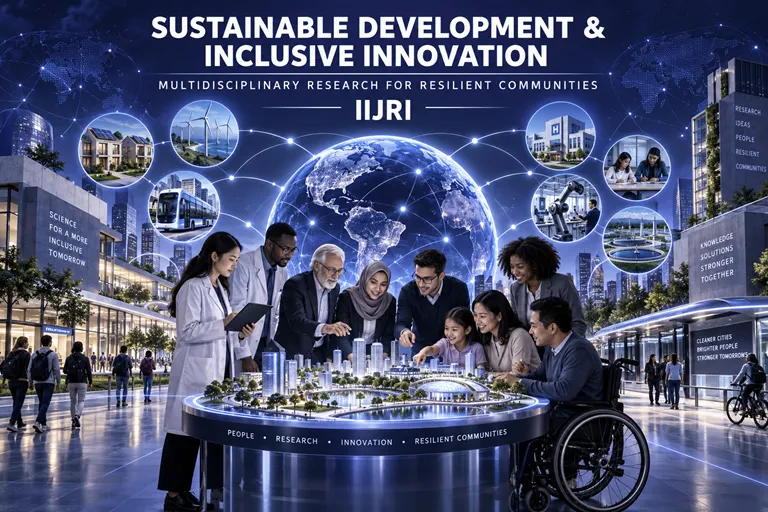
These connections make sustainable development and inclusive innovation important areas for multidisciplinary research.
The Intellecta International Journal of Research and Innovation (IIJRI) encourages researchers, academics, professionals, institutions and interdisciplinary teams to submit original and evidence-based studies that contribute to resilient communities and inclusive development.
As a multidisciplinary, peer-reviewed and open-access journal, IIJRI supports research that connects academic knowledge with practical social, environmental, technological and economic challenges. The journal welcomes scholarship addressing climate resilience, sustainable livelihoods, community health, inclusive education, responsible technology, circular systems, sustainable industry, social innovation and equitable public policy.
Why Sustainable Development Requires Multidisciplinary Research
Sustainable development is sometimes treated primarily as an environmental subject. In practice, environmental conditions are inseparable from health, education, income, infrastructure, technology, governance and social equality.
Flooding can interrupt schooling, damage health facilities, affect food supplies and reduce household income. Air pollution can increase disease burdens, reduce labour productivity and place additional pressure on healthcare services. Poorly planned urban development can intensify heat exposure, transportation inequality and housing insecurity. Digital transformation can improve access to services while excluding communities without devices, connectivity or digital literacy.
These relationships mean that research teams often need to combine perspectives from:
- Environmental science and climate studies.
- Engineering and technology.
- Medicine, nursing and public health.
- Agriculture and food science.
- Education and behavioural science.
- Economics and management.
- Sociology and community development.
- Architecture and urban planning.
- Public policy and governance.
- Law and ethics.
- Data science and artificial intelligence.
- Energy and industrial research.
Multidisciplinary research can help identify interactions that would remain invisible within a narrow disciplinary analysis. It can also improve the practical relevance of recommendations by considering the institutions, resources and communities responsible for implementation.
Understanding Inclusive Innovation
Inclusive innovation refers to the development of products, services, systems or policies that respond to the needs of diverse populations, including people who have historically been excluded from technological and economic progress.
An innovation may be technically effective without being inclusive. A water-purification system may produce excellent results but remain unaffordable for the communities that need it. A digital learning platform may offer high-quality materials but fail where students lack connectivity or accessible interfaces. A climate-monitoring application may provide accurate forecasts but remain unusable if information is not available in local languages.
Inclusive innovation therefore asks:
- Who participated in defining the problem?
- Who can access the proposed solution?
- Who can afford to use and maintain it?
- Does the innovation account for language, disability and digital literacy?
- Can it function under local infrastructure conditions?
- Whose knowledge has been included?
- Who receives the benefits?
- Who bears the risks or costs?
- Can affected communities influence implementation?
- Is the solution sustainable after initial funding ends?
Inclusion should not be added after an innovation has already been designed. It should guide the identification of the problem, research methodology, development process, evaluation and implementation.
What Makes a Community Resilient?
Community resilience is the capacity of people, institutions and local systems to prepare for, respond to and recover from disruption while maintaining essential functions and adapting to future risks.
Resilience does not mean that communities should be expected to manage crises without institutional support. It requires investment in infrastructure, health, education, social protection, environmental management and accountable governance.
A resilient community may demonstrate:
- Reliable access to water, food, energy and healthcare.
- Climate-adapted infrastructure.
- Local emergency planning.
- Strong social networks.
- Inclusive public institutions.
- Accessible education and skills development.
- Diverse livelihood opportunities.
- Effective communication systems.
- Community participation in decision-making.
- Protection for vulnerable populations.
- Capacity to learn from previous disruptions.
- Sustainable management of local resources.
Research should examine not only whether a community recovers from one event, but also whether recovery reduces vulnerability to future events.
Research Priority 1: Climate Adaptation and Disaster Resilience
Climate change is increasing exposure to extreme heat, flooding, drought, coastal risks, changing disease patterns and disruption to agriculture and infrastructure.
Research is needed to identify adaptation strategies suited to particular geographic, social and economic conditions.
IIJRI encourages studies addressing:
- Community-based climate adaptation.
- Flood and drought preparedness.
- Heat-resilient cities.
- Coastal-community protection.
- Climate-resilient housing.
- Early-warning systems.
- Disaster-risk communication.
- Climate-related migration.
- Resilient energy and water infrastructure.
- Nature-based adaptation.
- Public-health preparedness.
- Post-disaster recovery and reconstruction.
Local Knowledge and Community Participation
Communities often possess detailed knowledge of local landscapes, weather patterns, water systems and previous disasters. Researchers should consider how this knowledge can complement scientific modelling and technical assessment.
Participation should occur early enough to influence the research. Community members should not be treated only as sources of data or final recipients of a completed solution.
Climate Justice
Climate risks are not distributed equally. Low-income communities, informal settlements, small farmers, coastal populations, children, older people and persons with disabilities may experience greater exposure while having fewer resources for adaptation.
Climate-resilience studies should therefore examine:
- Who is most exposed.
- Who receives adaptation funding.
- Whether relocation is voluntary and fair.
- Whether vulnerable groups can participate in planning.
- How benefits and costs are distributed.
- Whether proposed solutions create new inequalities.
A technically successful adaptation project may still be socially unjust if it protects one population by transferring risk to another.
Research Priority 2: Sustainable Agriculture and Food Security
Agricultural systems face pressure from climate variability, soil degradation, water scarcity, biodiversity loss, rising costs and changing market conditions.
Research should support food systems that are productive, environmentally responsible, economically viable and accessible to farmers and consumers.
Priority areas include:
- Climate-resilient crops.
- Soil-health improvement.
- Efficient irrigation.
- Agroforestry.
- Integrated pest management.
- Sustainable livestock systems.
- Reduction of post-harvest losses.
- Food-storage innovation.
- Agricultural waste utilisation.
- Local food systems.
- Farmer cooperatives.
- Sustainable nutrition.
- Digital tools for smallholder agriculture.
Inclusive Agricultural Innovation
New agricultural technologies should be evaluated across different farm sizes and resource conditions. A solution requiring expensive machinery, continuous internet access or specialised maintenance may not be suitable for smallholder farmers.
Researchers should consider affordability, local repair capacity, language, training, land access and gender-related barriers.
Food Security and Community Well-Being
Food security involves more than producing enough food. It also requires affordability, nutritional quality, cultural suitability, reliable distribution and safe storage.
Multidisciplinary food research can connect agriculture with public health, economics, logistics, climate science and social policy.
Research Priority 3: Water Security and Sustainable Resource Management
Reliable access to safe water is central to public health, agriculture, industry and community stability. Water research must address both technical supply and questions of access, governance and long-term resource protection.
IIJRI welcomes research on:
- Water conservation.
- Rainwater harvesting.
- Groundwater management.
- Low-cost purification.
- Wastewater treatment and reuse.
- Water-quality monitoring.
- Smart irrigation.
- Community water governance.
- Floodwater management.
- Industrial water efficiency.
- Protection of watersheds.
- Water access in rural and informal settlements.
An effective water intervention should be assessed for safety, affordability, maintenance requirements and community acceptance. Technologies that cannot be repaired locally may fail after pilot funding or external technical support ends.
Research Priority 4: Inclusive and Climate-Resilient Healthcare
Environmental change, migration, poverty and unequal infrastructure influence health outcomes. Communities require healthcare systems capable of continuing essential services during emergencies and reaching people who are routinely underserved.
Research priorities include:
- Climate-sensitive disease surveillance.
- Community health systems.
- Rural healthcare access.
- Telemedicine and digital health.
- Maternal and child health.
- Portable diagnostic technologies.
- Mental-health support after disasters.
- Heat-related illness.
- Air pollution and respiratory health.
- Emergency healthcare planning.
- Accessible healthcare for persons with disabilities.
- Affordable medical innovation.
Digital Health and Inclusion
Digital healthcare can expand access, but its effectiveness depends on connectivity, digital literacy, language, privacy and integration with clinical services.
Researchers should examine who uses a digital intervention, who stops using it and who was never able to access it. Average adoption rates may conceal significant exclusion.
Frugal Healthcare Innovation
Affordable and locally maintainable healthcare technologies can provide substantial value in resource-constrained environments. However, lower cost must not mean reduced safety, weak validation or poor-quality evidence.
Frugal healthcare research should evaluate clinical reliability, usability, durability and implementation requirements.
Research Priority 5: Inclusive Education and Community Capacity
Education strengthens resilience by helping people understand risks, develop skills, participate in public decisions and adapt to economic and technological change.
However, access to quality education remains unequal. Digital learning may expand educational opportunity while creating new barriers for learners without devices, connectivity or appropriate support.
Relevant research areas include:
- Education during disasters and displacement.
- Digital learning in low-connectivity settings.
- Inclusive and special education.
- Community-based learning.
- Teacher development.
- Sustainability education.
- Vocational education.
- Adult literacy.
- Skills for green employment.
- Responsible artificial intelligence in education.
- Multilingual learning.
- Open educational resources.
Education for Sustainable Development
Education for sustainable development should help learners understand environmental systems, social responsibility, public health and economic choices. It should also support critical thinking and practical problem-solving.
Research may investigate how sustainability can be integrated into curricula, professional training, community education and institutional practice.
Lifelong Learning and Just Transitions
The transition towards cleaner technologies and sustainable industries will change employment patterns. Workers may require new technical, digital and managerial skills.
Research should examine how reskilling can reach people across different ages, income groups, educational backgrounds and locations. A sustainable economic transition cannot be considered inclusive if workers and communities are left without realistic alternatives.
Research Priority 6: Sustainable Livelihoods and Local Economic Resilience
Communities are more resilient when households have stable and diverse sources of income. Livelihood research should consider environmental sustainability alongside economic security and social protection.
IIJRI encourages studies on:
- Green employment.
- Rural entrepreneurship.
- Women-led enterprises.
- Cooperative business models.
- Sustainable tourism.
- Community-owned energy.
- Local manufacturing.
- Inclusive finance.
- Social enterprises.
- Informal-sector resilience.
- Micro, small and medium enterprises.
- Skills development.
- Livelihood recovery after disasters.
Supporting Local Enterprise
Small enterprises frequently face difficulties involving finance, market access, technology, regulation and supply-chain instability. Research can identify practical models for helping local businesses participate in sustainable economic development.
Gender and Livelihood Inclusion
Women may face barriers involving property ownership, access to finance, unpaid care work, mobility and participation in decision-making. Sustainable-livelihood research should examine these barriers explicitly rather than assuming that economic growth benefits all groups equally.
Research Priority 7: Sustainable Cities and Inclusive Infrastructure
Urban areas concentrate population, economic activity, infrastructure and environmental risk. Sustainable urban development must combine technical efficiency with affordability and social inclusion.
Priority topics include:
- Affordable climate-resilient housing.
- Sustainable public transportation.
- Walkable neighbourhoods.
- Urban heat reduction.
- Green public spaces.
- Inclusive sanitation.
- Air-quality improvement.
- Waste management.
- Renewable urban energy.
- Accessible infrastructure.
- Resilient informal settlements.
- Participatory urban planning.
Smart Cities and Inclusive Governance
Digital technologies can support traffic management, energy use, public safety and service delivery. However, a city does not become inclusive simply by becoming more digitally connected.
Smart-city research should examine:
- Data protection.
- Accessibility.
- Algorithmic accountability.
- Public participation.
- Surveillance risks.
- Digital exclusion.
- Procurement transparency.
- Long-term maintenance.
- Benefits for underserved neighbourhoods.
Technology should strengthen public services without weakening privacy, fairness or democratic accountability.
Research Priority 8: Circular Economy and Community-Based Resource Recovery
The circular economy seeks to reduce waste by keeping materials, products and resources in use for longer.
Research may explore:
- Repair and reuse systems.
- Product durability.
- Recycling infrastructure.
- Composting.
- Construction-material recovery.
- Electronic-waste management.
- Agricultural-waste applications.
- Industrial symbiosis.
- Textile reuse.
- Plastic alternatives.
- Community recycling enterprises.
- Sustainable product design.
Moving Beyond Recyclability Claims
A product may be technically recyclable but still enter landfill if collection, separation and processing systems are unavailable.
Researchers should distinguish between:
- Theoretical recyclability.
- Actual material recovery.
- Waste reduction.
- Product-life extension.
- Energy used in recycling.
- Transportation requirements.
- Replacement of newly extracted materials.
Circularity should be evaluated across the complete life cycle rather than through a single favourable indicator.
Research Priority 9: Responsible Technology and Digital Inclusion
Technology can support climate monitoring, healthcare, education, agriculture, governance and disaster response. It can also widen inequality when access is limited or systems are designed without understanding local conditions.
Inclusive digital innovation should consider:
- Device and internet access.
- Affordability.
- Digital literacy.
- Disability accessibility.
- Language diversity.
- Data privacy.
- Cybersecurity.
- Local technical support.
- User participation.
- Offline functionality.
- Responsible artificial intelligence.
- Long-term maintenance.
Researchers should avoid treating technology adoption as the final measure of success. The more important question is whether the technology improves outcomes without creating avoidable harm or exclusion.
Research Priority 10: Participatory Governance and Social Innovation
Communities become more resilient when people can participate meaningfully in decisions affecting their lives.
Participatory governance research may examine:
- Community disaster planning.
- Participatory budgeting.
- Local climate councils.
- Citizen science.
- Community monitoring.
- Cooperative institutions.
- Public consultation.
- Grievance and appeal mechanisms.
- Local development planning.
- Community ownership of infrastructure.
Social innovation can include new organisational, financial or governance arrangements rather than a physical technology. Examples include community-owned renewable energy, cooperative food networks, shared transportation, local health programmes and neighbourhood learning centres.
Research should assess whether these models are inclusive, financially sustainable and capable of continuing beyond pilot stages.
Building Effective Community-University Partnerships
Universities can contribute to resilient communities through research, education, technical support and long-term institutional partnerships.
Effective partnerships require more than short-term data collection.
Co-Define Research Problems
Researchers should work with communities to identify priorities. The research question should reflect local concerns rather than only academic funding trends.
Recognise Community Knowledge
Residents, local organisations and practitioners possess knowledge that may not be documented in academic literature. This expertise should be respected and appropriately acknowledged.
Establish Clear Roles
Partners should understand who is responsible for data collection, decision-making, communication, implementation and follow-up.
Share Research Findings Accessibly
Academic publications are important, but communities may also benefit from translated summaries, workshops, visual materials, policy notes or practical guidance.
Plan for Continuity
Researchers should consider what happens after the project ends. Technologies, databases and community programmes require ownership, maintenance and resources.
Measure Mutual Benefit
Partnership evaluation should examine whether the community gained useful knowledge, capacity or services, rather than focusing only on academic outputs.
A Research Framework for Inclusive and Resilient Innovation
Researchers preparing sustainability or community-resilience studies may use the following framework.
Step 1: Define the Community Challenge
Describe the environmental, health, educational, economic or infrastructure problem using available evidence and community perspectives.
Step 2: Identify Affected Groups
Determine who is most exposed, who may benefit and who could be excluded or harmed.
Step 3: Build a Multidisciplinary Team
Include the scientific, technical, social, economic and policy expertise needed to understand the problem.
Step 4: Engage Stakeholders Early
Consult residents, local institutions, practitioners, businesses and policymakers before finalising the intervention.
Step 5: Evaluate Alternatives
Compare technological, organisational, policy and community-based approaches rather than assuming that one preferred solution is necessary.
Step 6: Assess Environmental and Social Effects
Examine resource consumption, emissions, affordability, accessibility, employment and distribution of benefits.
Step 7: Test Under Real Conditions
Pilot the intervention in a realistic setting with representative users and operational constraints.
Step 8: Measure Resilience Outcomes
Evaluate whether the intervention improves preparedness, continuity, recovery and capacity to adapt.
Step 9: Respond to Evidence
Modify or discontinue the approach if evaluation identifies unacceptable risks, exclusion or poor performance.
Step 10: Communicate Transparently
Report methods, limitations, negative findings, conflicts of interest and uncertainty.
Measuring Sustainability, Inclusion and Resilience
Research claims should be supported by appropriate indicators.
Environmental Indicators
- Energy consumption.
- Greenhouse-gas emissions.
- Water use.
- Waste generation.
- Material recovery.
- Soil and air quality.
- Biodiversity effects.
- Resource efficiency.
Social and Inclusion Indicators
- Affordability.
- Accessibility.
- Community participation.
- Gender inclusion.
- Disability access.
- Language accessibility.
- Distribution of benefits.
- User trust.
- Health and educational outcomes.
Economic Indicators
- Implementation cost.
- Maintenance cost.
- Local employment.
- Household-income effects.
- Business continuity.
- Financial accessibility.
- Long-term viability.
- Local economic contribution.
Resilience Indicators
- Preparedness.
- Speed of recovery.
- Continuity of essential services.
- Adaptability.
- Institutional coordination.
- Community knowledge.
- Redundancy of critical systems.
- Protection of vulnerable populations.
An intervention should not be described as sustainable or inclusive on the basis of one indicator alone. Researchers should report trade-offs openly.
Manuscript Types Welcomed by IIJRI
IIJRI welcomes multidisciplinary scholarship on sustainable development, inclusive innovation and resilient communities in forms such as:
- Original research articles.
- Systematic and structured reviews.
- Community case studies.
- Technical studies.
- Policy analyses.
- Comparative research.
- Implementation research.
- Conceptual and theoretical papers.
- Participatory research.
- Social-impact studies.
- Sustainability assessments.
- Interdisciplinary research articles.
Submissions should present a clear research question, appropriate methodology, transparent analysis and conclusions supported by evidence.
Submit Sustainable Development Research to IIJRI
Is your research helping communities become more sustainable, inclusive and resilient?
IIJRI welcomes original research, reviews, case studies, policy analyses and technical studies addressing climate adaptation, public health, education, sustainable livelihoods, agriculture, circular systems, responsible technology and community innovation.
Researchers are encouraged to submit work that combines academic rigour with practical, social or environmental relevance.
Review the IIJRI Author Guidelines
Submit Your Manuscript Online
Frequently Asked Questions
What is inclusive innovation?
Inclusive innovation involves developing products, services, systems or policies that respond to the needs of diverse populations, particularly communities that may be excluded because of income, location, disability, language, gender or limited infrastructure.
How is inclusive innovation connected with sustainable development?
Inclusive innovation helps ensure that environmental and technological progress produces broadly shared benefits. It considers affordability, accessibility, participation and long-term social value alongside technical performance.
What is community resilience?
Community resilience is the capacity of people, institutions and local systems to prepare for disruption, maintain essential functions, recover and adapt to future risks.
Why is multidisciplinary research important for resilient communities?
Community challenges involve interacting environmental, health, technological, educational, economic and social factors. Multidisciplinary research can examine these relationships and develop more practical solutions.
What sustainability topics does IIJRI encourage?
IIJRI encourages research on climate adaptation, renewable energy, circular systems, sustainable agriculture, water security, community health, inclusive education, resilient infrastructure, responsible technology and sustainable livelihoods.
Can community-based research be submitted to IIJRI?
Yes. The journal welcomes rigorous community case studies, participatory research, implementation studies and evaluations of local innovation, provided the methods and ethical considerations are clearly reported.
Does sustainable-development research need to involve new technology?
No. Sustainable innovation may involve policies, governance models, educational programmes, community organisations, financial systems or improvements to existing practices.
What is climate-resilience research?
Climate-resilience research examines how communities, infrastructure, ecosystems and institutions can prepare for, respond to and adapt to climate-related risks.
How can researchers demonstrate that an innovation is inclusive?
Researchers can evaluate affordability, accessibility, stakeholder participation, performance across groups, language suitability, disability access and the distribution of benefits and risks.
What is the role of local knowledge in sustainability research?
Local knowledge can provide important insight into environmental conditions, community priorities, traditional practices and implementation challenges. It can complement scientific and technical evidence.
What types of manuscripts can authors submit?
Suitable manuscript types may include original research, reviews, case studies, technical papers, policy analyses, comparative studies, implementation research and interdisciplinary scholarship.
How can researchers submit a manuscript to IIJRI?
Authors should review the IIJRI Author Guidelines and submit through the journal’s online manuscript-submission system.
Conclusion
Sustainable development requires more than isolated environmental projects or short-term technological interventions. It requires research that understands the connections among climate, health, education, livelihoods, infrastructure, governance and social inclusion.
Inclusive innovation strengthens this approach by asking who participates, who benefits, who may be excluded and whether a solution can operate sustainably under real community conditions.
Resilient communities are created through reliable public systems, strong social networks, sustainable resource management, accessible education, diversified livelihoods and meaningful participation in decision-making. Research can help identify which approaches work, under what conditions and for whom.
The Intellecta International Journal of Research and Innovation encourages multidisciplinary scholarship that connects academic knowledge with the practical needs of communities. Researchers examining sustainability, climate resilience, social innovation, community health, inclusive technology, education, agriculture, industry and public policy are invited to contribute original and rigorous work.
By publishing transparent, context-sensitive and socially relevant research, IIJRI seeks to support knowledge that helps communities prepare for change, reduce inequality and build a more sustainable future.
Researchers may review the journal’s submission requirements and submit their manuscripts online.
Publishing-support note: Universities, societies and research institutions planning to launch or modernise scholarly journals may obtain support for ScholarJMS journal websites and editorial workflows, OJS hosting or migration through OJSCloud, ISSN-readiness consulting, Crossref DOI workflow guidance through GetDOI and transparent peer-review infrastructure through Scholar9. For guidance, contact WhatsApp: +91 82003 85143 or inquiry@ojscloud.com.