
Building a Professional Journal Website with Online Submission, Peer Review and Structured Article Publishing
Launching an academic journal requires more than creating a homepage, uploading a logo and providing an email address for manuscript submission. A scholarly journal website must support the complete publishing lifecycle, from the author’s first visit to the long-term presentation and maintenance of published research.
Authors use the website to evaluate the journal’s scope, Editorial Board, policies and submission requirements. Reviewers depend on organised access to manuscripts and evaluation instructions. Editors need reliable tools for screening submissions, selecting reviewers, recording decisions and managing revisions. Readers expect stable article pages, accurate citation details and convenient access to current and previous issues.
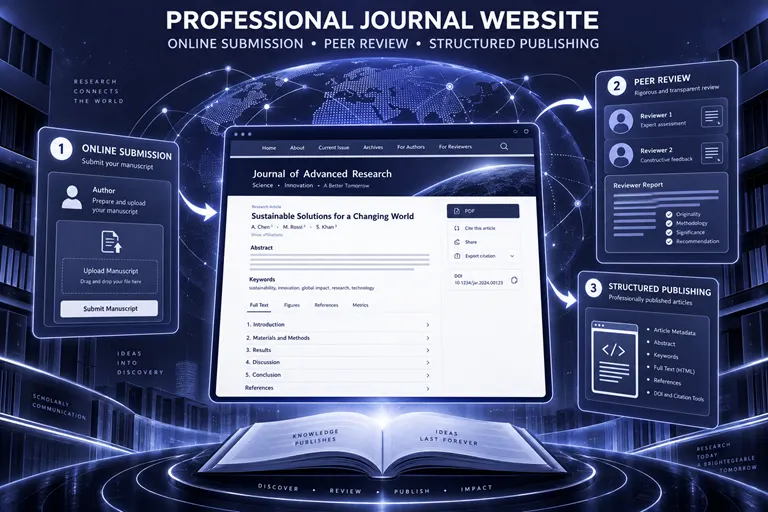
Universities, scholarly societies, research institutions and independent publishers should therefore approach journal website development as a publishing-infrastructure project rather than a design exercise alone.
The Intellecta International Journal of Research and Innovation (IIJRI) provides a practical example of an emerging multidisciplinary journal using an integrated digital environment. Through ScholarJMS, IIJRI brings together journal information, online manuscript submission, manuscript tracking, double-blind peer-review support, editorial management, policies, current issues, archives and structured article publishing.
This News & Event article explains the essential components of a professional journal website and outlines how publishers can plan submission, peer review, metadata, DOI registration, ISSN readiness, discoverability and long-term technical maintenance.
A Journal Website Is Part of the Scholarly Record
A commercial website may be redesigned or replaced without affecting a formal scholarly record. An academic journal website carries greater responsibility.
It may contain:
- Official journal information.
- Editorial policies.
- Author instructions.
- Editorial Board details.
- Unpublished manuscript records.
- Reviewer reports.
- Editorial decisions.
- Published articles.
- Correction and retraction notices.
- Copyright and licensing information.
- Citation metadata.
- DOI landing pages.
- Volume and issue archives.
These records must be accurate, accessible and maintained over time.
The website should also reflect the journal’s real editorial practices. If the journal describes a double-blind peer-review process, its manuscript preparation and reviewer workflow should support that model. If the journal claims to publish quarterly, its production planning should make that schedule realistic.
A professional website creates transparency, but transparency is useful only when the published information is consistent with actual operations.
Begin with the Journal’s Academic Identity
Technical development should begin after the publisher has defined what the journal is, whom it serves and how it will operate.
Establish the Scope
Aims and scope should identify:
- Core disciplines.
- Interdisciplinary areas.
- Research questions of interest.
- Accepted methodologies.
- Article types.
- Intended author groups.
- Intended readers.
- Excluded or unsuitable topics.
- Geographic or institutional focus where relevant.
- The practical or academic contribution expected from submissions.
For a multidisciplinary journal such as IIJRI, the scope should welcome research across fields without becoming so broad that authors and reviewers cannot understand its academic purpose.
Define the Publishing Model
The publisher should decide:
- Whether access is open or subscription-based.
- Publication frequency.
- Whether articles are published by issue or continuously.
- Peer-review model.
- Publishing language.
- Copyright arrangement.
- Licence terms.
- Publication charges, if any.
- Editorial ownership.
- Long-term archiving approach.
Assign Operational Responsibilities
A functioning journal requires clear responsibility for:
- Editorial screening.
- Reviewer selection.
- Decision-making.
- Author communication.
- Copyediting.
- Proofreading.
- Typesetting.
- Metadata verification.
- DOI registration.
- Issue publication.
- Website administration.
- Backups and security.
- Policy maintenance.
- Corrections and retractions.
A journal platform can organise tasks, but the publisher must still assign accountable people to perform them.
Essential Pages for a Professional Journal Website
Visitors should be able to locate important journal information without searching through a complicated navigation structure.
Homepage
The homepage should present the journal’s identity clearly. It may include:
- Full journal title.
- Logo and visual identity.
- Short journal description.
- Core subject areas.
- Publisher information.
- Open-access and peer-review model.
- Publication frequency.
- ISSN status or assigned ISSN.
- Current issue.
- Recent articles.
- Call for papers.
- Submission button.
- Important notices.
- Contact route.
The homepage should guide visitors towards their intended tasks. Authors may want to submit a manuscript, while readers may want to access the latest issue. These pathways should be immediately visible.
About the Journal
The About page should explain the journal’s purpose, academic positioning, ownership and publishing approach.
It should avoid unsupported statements about global impact, indexing or ranking. Credibility comes from clear and verifiable information.
Aims and Scope
The scope page should help authors decide whether their manuscript belongs in the journal. A vague statement claiming to publish work from every discipline provides little editorial guidance.
The page should include enough detail for editors to make consistent scope decisions and for reviewers to understand the journal’s academic priorities.
Editorial Board
A transparent Editorial Board page should present:
- Full name.
- Editorial role.
- Institutional affiliation.
- Country.
- Department or subject expertise.
- ORCID or institutional profile where appropriate.
Individuals should be listed only with their knowledge and consent. Affiliations should be reviewed regularly.
Author Guidelines
Author instructions should explain:
- Accepted manuscript types.
- Manuscript structure.
- Word limits where applicable.
- Abstract and keyword requirements.
- Referencing style.
- Tables and figures.
- Supplementary files.
- Ethical approval.
- Informed consent.
- Funding disclosure.
- Conflicts of interest.
- Author contributions.
- Data-availability statements.
- Artificial-intelligence use.
- Copyright and licensing.
- Revision requirements.
- Submission procedure.
Clear instructions reduce preventable technical corrections and editorial correspondence.
Policy Hub
A journal’s policy section may need to address:
- Peer review.
- Publication ethics.
- Authorship and contributorship.
- Plagiarism and duplicate publication.
- Conflicts of interest.
- Human and animal research.
- Informed consent.
- Complaints and appeals.
- Corrections and retractions.
- Data sharing.
- Artificial-intelligence use.
- Open access.
- Copyright and licensing.
- Publication charges and refunds.
- Editorial independence.
- Archiving and preservation.
- Privacy.
Policies should be adapted to the journal’s real scope and procedures. Copying another publisher’s policy language without operational alignment can create contradictions.
Current Issue and Archives
Each issue should have a dedicated page showing:
- Volume and issue number.
- Publication year and date.
- Table of contents.
- Article titles.
- Author names.
- Article types.
- Page ranges or article numbers.
- DOI links where assigned.
- Full-text access.
Archives should be organised predictably by year, volume and issue.
Why Email Submission Becomes Difficult to Manage
Email may appear convenient during the first months of a new journal. As submissions increase, it creates operational risks.
Files may be stored under inconsistent names. Revised manuscripts can become mixed with original versions. Reviewer comments may remain in personal inboxes. Editors may be unable to determine whether a decision letter was sent or which author declaration is current.
Email-based management also makes staff transitions difficult. When an editor leaves, part of the journal’s record may remain within that person’s account.
A dedicated online manuscript-submission system creates a central record for each paper.
What an Online Submission System Should Collect
A complete submission form may collect:
- Manuscript title.
- Article type.
- Abstract.
- Keywords.
- Subject classification.
- Corresponding-author details.
- Co-author names.
- Affiliations.
- ORCID identifiers.
- Main manuscript file.
- Tables and figures.
- Supplementary files.
- Cover letter.
- Ethical approval information.
- Funding statement.
- Conflict-of-interest declaration.
- Author-contribution statement.
- Data-availability statement.
- Suggested reviewers where permitted.
- Copyright or licensing confirmation.
- Agreement with journal policies.
The system should assign a manuscript reference and acknowledge successful submission.
Manuscript Tracking
Authors should be able to access meaningful status information. Possible stages include:
- Submission received.
- Technical screening.
- Correction requested.
- Editor assigned.
- Under editorial assessment.
- Reviewers invited.
- Under peer review.
- Revision requested.
- Revised manuscript received.
- Final decision pending.
- Accepted.
- Rejected.
- In production.
- Published.
Status labels should describe the real editorial position. A manuscript should not be marked as under review before a reviewer has accepted the assignment.
Editorial Screening Before Peer Review
Not every submission should move directly to external review.
Initial screening helps determine whether the manuscript:
- Fits the journal’s scope.
- Follows basic author instructions.
- Includes all necessary files.
- Contains the required declarations.
- Presents a recognisable scholarly contribution.
- Meets minimum language and presentation standards.
- Includes ethical approval where required.
- Raises plagiarism or duplicate-submission concerns.
- Uses appropriate research methods.
- Is suitable for external evaluation.
The editor may then:
- Progress the manuscript to peer review.
- Request technical corrections.
- Ask for missing documentation.
- Seek an internal methodological opinion.
- Issue a desk rejection.
This stage protects reviewer time and supports consistent journal standards.
Building a Reliable Peer-Review Workflow
Peer review is not simply the forwarding of a manuscript to two researchers. It is a controlled editorial process involving expertise, confidentiality, conflicts of interest, deadlines and reasoned judgement.
Choose and Publish the Review Model
Common models include:
- Single-anonymous peer review.
- Double-anonymous peer review.
- Open peer review.
- Transparent peer review.
- Post-publication review.
IIJRI follows a double-blind peer-review process. Under this model, author and reviewer identities are normally concealed from one another during evaluation.
Prepare the Review File
For double-blind review, the journal should inspect the manuscript for identifying information in:
- Title pages.
- Acknowledgements.
- Self-referencing statements.
- File properties.
- Ethical approval information.
- Supplementary files.
- Tracked changes.
- Embedded comments.
Complete anonymity cannot always be guaranteed, particularly in highly specialised fields. Appropriate file preparation can nevertheless reduce unnecessary disclosure.
Select Suitable Reviewers
Reviewer selection should consider:
- Subject expertise.
- Methodological knowledge.
- Relevant publication experience.
- Institutional relationships.
- Recent collaboration.
- Financial or professional conflicts.
- Availability.
- Ability to provide an objective assessment.
Editors should avoid selecting reviewers solely through keyword matching. A multidisciplinary paper may require evaluation by specialists from more than one field.
Provide Structured Reviewer Tools
Reviewers should receive:
- The anonymised manuscript.
- Relevant supplementary files.
- Review instructions.
- Evaluation criteria.
- Due date.
- Conflict-of-interest requirements.
- A form for author-facing comments.
- A field for confidential editorial comments.
- Clear recommendation options.
Structured forms can improve consistency, but reviewers should have enough space to explain their reasoning.
Preserve Editorial Judgement
Reviewer recommendations advise the editor. They do not automatically determine the outcome.
The editor should evaluate:
- Relevance and quality of each review.
- Whether comments are supported by evidence.
- Whether requested changes are reasonable.
- Whether reports conflict.
- Whether another reviewer is required.
- Whether an ethical concern has emerged.
- Whether the manuscript can be improved through revision.
Final decisions should remain with authorised editors.
Managing Revisions and Version Control
A revision may include:
- Clean revised manuscript.
- Tracked-changes version.
- Point-by-point response.
- Corrected tables.
- Replacement figures.
- Revised supplementary files.
- Updated ethical or authorship declarations.
The system should preserve the original submission and every subsequent version. Editors and reviewers must be able to identify which files belong to the current revision round.
Authors should respond to each substantive comment and explain where the manuscript was changed. When they disagree with a recommendation, they should provide a reasoned response.
Version control protects the integrity of the editorial record and reduces avoidable publication errors.
Need Help Building a Professional Journal Website?
We support universities, research institutions, scholarly societies and independent publishers with:
- ScholarJMS journal website development.
- Online manuscript submission.
- Author and manuscript tracking.
- Editorial screening workflows.
- Peer-review management.
- Revision and decision workflows.
- Issue and article-publishing structure.
- OJS hosting and technical support.
- OJS-to-ScholarJMS migration.
- ISSN consulting and website-readiness assessment.
- Crossref DOI setup and workflow guidance.
- Journal launch and publishing consultation.
WhatsApp: +91 82003 85143
Email: inquiry@ojscloud.com
Moving from Acceptance to Publication
Acceptance is an editorial milestone, not the final publishing stage. The article must be prepared for accurate and consistent release.
Copyediting
Copyediting may cover:
- Grammar and language.
- Terminology.
- Heading hierarchy.
- Citation and reference consistency.
- Tables and figures.
- Author names.
- Affiliations.
- ORCID identifiers.
- Funding information.
- Conflict-of-interest statements.
- Ethical declarations.
- Data availability.
- Copyright and licensing.
Copyediting should improve clarity without changing the author’s scholarly meaning.
Typesetting
The article should be prepared using the journal’s approved publication format. The design should remain consistent across articles and issues.
Important elements include:
- Journal title and branding.
- Article title.
- Author and affiliation presentation.
- Abstract and keywords.
- Heading structure.
- Tables and figures.
- Citation details.
- DOI where assigned.
- Copyright and licence statement.
- Page numbering or article number.
- Publication dates.
Proof Review
Authors should be given an opportunity to identify production errors. Proof review should not normally be used to add new results or rewrite major sections.
The journal should record approval before publication.
What Structured Article Publishing Means
Structured article publishing means presenting research as a complete digital scholarly object rather than only uploading a PDF.
Every article should have a stable landing page containing bibliographic and descriptive information.
A strong article page may include:
- Article title.
- Author names.
- Institutional affiliations.
- ORCID identifiers.
- Abstract.
- Keywords.
- Article type.
- Publication date.
- Volume and issue.
- Page range or article number.
- DOI.
- Citation format.
- Full-text links.
- Copyright and licence.
- Received, revised and accepted dates.
- Funding statement.
- Conflict-of-interest declaration.
- Data-availability information.
- References.
- Supplementary files.
Why a Landing Page Matters
A dedicated article page supports:
- Reader understanding.
- Reliable citation.
- DOI resolution.
- Search-engine discovery.
- Metadata exchange.
- Internal linking.
- Access to multiple file formats.
- Corrections and updates.
- Long-term record management.
A DOI should resolve to the article landing page rather than directly to a PDF stored at a temporary address.
HTML, PDF and XML
Different formats perform different functions.
- HTML supports online reading, mobile accessibility, internal navigation and search visibility.
- PDF provides a stable downloadable and printable version.
- XML can support structured data exchange, repository workflows and preservation requirements.
- Supplementary files may provide datasets, appendices, multimedia or additional methods.
The appropriate combination depends on the journal’s resources, subject field and discovery requirements.
Metadata as Publishing Infrastructure
Metadata describes the journal and its articles in a structured form.
Important fields include:
- Journal title.
- Article title.
- Author names.
- Affiliations.
- Abstract.
- Keywords.
- Article type.
- Publication date.
- Volume and issue.
- Page range or article number.
- DOI.
- References.
- Funding information.
- Copyright and licence.
Metadata errors can spread across external services. A misspelled author name may affect attribution. An incorrect article title may appear in citations. A wrong URL may prevent a DOI from resolving to the intended page.
Metadata should therefore be verified before publication and corrected when necessary.
Crossref DOI Planning for New Journals
A Digital Object Identifier provides a persistent identifier for an article or another scholarly object. DOI registration requires more than generating a string and placing it on a PDF.
A reliable DOI workflow includes:
- An authorised registration route.
- A DOI prefix.
- A consistent suffix convention.
- A live landing page.
- Complete article metadata.
- Metadata deposit with Crossref.
- Resolution testing.
- Ongoing metadata maintenance.
DOI Metadata Quality
Journals should verify:
- Author names.
- Article title.
- Journal title.
- Publication date.
- Volume and issue.
- Article URL.
- Licence details where included.
- Funding information where included.
- References where deposited.
If an article is corrected or moved, the corresponding DOI metadata may require an update.
GetDOI can assist eligible journals with Crossref sponsorship routes, DOI setup, metadata preparation and registration-workflow guidance.
DOI registration is not journal indexing. It provides persistent identification and metadata services, while indexing databases apply separate evaluation and selection criteria.
Preparing a Journal Website for ISSN Application
An ISSN identifies a continuing publication. It does not certify journal quality, ranking or indexing.
Before applying, a new online journal should generally present a coherent and complete publication identity.
Website-readiness may include:
- Final journal title.
- Publisher details.
- Editorial ownership.
- Aims and scope.
- Editorial Board.
- Publication frequency.
- Author instructions.
- Peer-review policy.
- Publication-ethics policies.
- Copyright and licensing.
- Contact information.
- Published content or other materials requested by the relevant ISSN centre.
- Consistent title presentation across pages and files.
Requirements vary by jurisdiction and the responsible ISSN authority. The final decision remains with that authorised agency.
OJSCloud can help publishers with ISSN consulting, website-readiness reviews and journal launch planning. Consulting may identify missing pages, inconsistent title presentation or incomplete policies before an application is made.
No platform or consultant should guarantee ISSN approval.
Designing for Search Visibility and Indexing Readiness
A journal website should be understandable to readers, search engines and scholarly discovery systems.
Important technical elements include:
- Secure HTTPS.
- Mobile-responsive design.
- Fast page loading.
- Stable URLs.
- Unique page titles.
- Meta descriptions.
- Canonical URLs where needed.
- XML sitemap.
- Logical heading structure.
- Accessible navigation.
- Article-level metadata.
- Citation meta tags where supported.
- Internal links.
- Searchable full text.
- Image alternative text.
Journal Content Strategy
A journal can strengthen visibility by publishing useful content connected to its actual scope, including:
- Research-trend articles.
- Author guidance.
- Methodology resources.
- Calls for papers.
- Special-issue announcements.
- Editorial updates.
- Summaries of published research.
- News and Events.
Keyword repetition should not replace meaningful content. Long-term journal SEO depends on clear subject positioning, reliable publication, strong metadata and useful scholarly pages.
Accurate Indexing Statements
Journal websites should distinguish among:
- Formal indexing.
- Search-engine visibility.
- DOI registration.
- Metadata registration.
- Repository inclusion.
- Indexing applications.
- Citation-database coverage.
Only verified inclusion should be described as indexing.
Security and Privacy Requirements
Journal systems store unpublished intellectual work and personal information. Security should therefore be considered from the beginning.
Important protections include:
- Secure connections.
- Role-based access.
- Strong authentication.
- Restricted access to reviewer identities.
- Secure file storage.
- Reliable backups.
- Software updates.
- Recovery planning.
- Privacy policies.
- Activity records.
- Spam and malicious-upload protection.
- Controlled administrator privileges.
Authors, reviewers, editors and technical administrators should access only the information required for their responsibilities.
Accessibility and Mobile Performance
Researchers may visit journal websites through mobile phones, assistive technologies or slower connections.
A usable website should provide:
- Responsive page layouts.
- Readable text.
- Clear colour contrast.
- Keyboard navigation.
- Logical heading order.
- Descriptive form labels.
- Alternative text for informative images.
- Accessible document formats.
- Responsive tables.
- Clear form-error messages.
- Lightweight and optimised media.
Accessibility supports wider participation in scholarly communication and should not be treated as an optional design feature.
Choosing Between ScholarJMS and OJS
The right platform depends on the journal’s workflow, internal technical capacity and support requirements.
ScholarJMS
ScholarJMS provides an integrated environment for:
- Professional journal websites.
- Manuscript submission.
- Author tracking.
- Editorial workflows.
- Reviewer coordination.
- Revision management.
- Issue publishing.
- Structured article pages.
- Journal policies and public content.
- Archive presentation.
- Publisher operations.
It is suitable for journals that want their public website and editorial-management environment connected within one supported system.
Open Journal Systems
Open Journal Systems is an established open-source publishing platform. It can support submission, peer review and publication, but the journal must plan for:
- Hosting.
- Installation.
- Configuration.
- Theme development.
- Software upgrades.
- Backups.
- Security.
- Plugin compatibility.
- Technical troubleshooting.
- Workflow training.
OJSCloud supports publishers requiring managed OJS hosting, upgrades, migration, technical assistance and publishing consultation.
Questions to Ask Before Choosing
Publishers should evaluate:
- Is the system easy for authors and editors?
- Can the workflow reflect the journal’s policies?
- Who will manage updates and security?
- Are backups included?
- Can the website present articles professionally?
- Does it support appropriate metadata?
- Is technical support available?
- Can existing archives be migrated?
- Can the platform grow with the journal?
- What is the long-term operating cost?
The correct choice is the platform that meets the journal’s real requirements and can be maintained reliably.
OJS-to-ScholarJMS Migration
An existing journal may consider migration when technical limitations, maintenance demands or workflow problems affect publishing operations.
Migration should begin with an audit of:
- OJS version.
- Published issues.
- Article metadata.
- PDF and supplementary files.
- Users and roles.
- Active submissions.
- Editorial records.
- DOI registrations.
- Existing URLs.
- Plugins and customisations.
- Backup availability.
A migration plan may include:
- Verified database and file backups.
- Metadata export and mapping.
- Transfer of publication files.
- Reconstruction of issues and articles.
- Preservation of DOI destinations.
- URL redirect planning.
- User-role review.
- Workflow configuration.
- Submission testing.
- Post-launch verification.
Migration is not simply the movement of visible pages. It involves protecting the scholarly record and ensuring that readers can continue reaching published content.
Transparent Peer Review and Scholar9
Some publishers are exploring transparent peer-review models to make parts of the evaluation process more visible.
Depending on journal policy and participant consent, transparency may involve:
- Publication of reviewer reports.
- Publication of author responses.
- Reviewer recognition.
- Documentation that review occurred.
- Identifiers for review-related outputs.
Scholar9 supports a transparent peer-review and research-trust ecosystem.
A journal considering this approach should establish:
- What information will be published.
- Whether reviewer names remain confidential.
- How consent will be obtained.
- How sensitive information will be protected.
- Whether author responses will be public.
- How review records will be corrected.
Transparent review should strengthen trust without creating inappropriate risk for authors or reviewers.
Need a Complete Journal Publishing Solution?
We provide connected support for new and established journals:
- ScholarJMS for professional websites, online submission, editorial workflow, peer-review management and article publishing.
- OJSCloud for managed OJS hosting, support, migration, journal launch guidance and ISSN consulting.
- GetDOI for Crossref DOI sponsorship routes, metadata preparation and DOI workflow support.
- Scholar9 for transparent peer-review and research-trust infrastructure.
We can assist with:
- New journal website setup.
- ScholarJMS implementation.
- OJS installation and hosting.
- OJS-to-ScholarJMS migration.
- Submission and review workflows.
- ISSN-readiness assessment.
- Crossref DOI planning.
- Article metadata structure.
- Policy and author-page preparation.
- Issue and archive organisation.
- Journal launch consulting.
WhatsApp: +91 82003 85143
Email: inquiry@ojscloud.com
Common Mistakes to Avoid
Building a Website Without a Publishing Workflow
A visually attractive homepage does not solve manuscript tracking, reviewer coordination, revision management or publication-record requirements.
Accepting Papers Before Policies Are Complete
The journal should not begin accepting manuscripts until its scope, author instructions, review process and essential ethical policies are ready.
Using Email as the Permanent Editorial System
Email can support communication, but it should not remain the only record of submissions, reviews, decisions and manuscript versions.
Publishing Only a PDF
Every article should have a dedicated landing page containing complete metadata and a stable access route.
Using Inconsistent Journal Information
The title, publisher, frequency, ISSN, licence and editorial details should match across the website, PDFs, DOI records and external profiles.
Registering DOIs Without a Maintenance Plan
DOI metadata must be verified and updated when article information or URLs change.
Claiming Unverified Indexing
Indexing claims should be confirmed directly and stated accurately.
Ignoring Security and Backups
The journal should maintain reliable backups, controlled permissions and recovery procedures.
Treating Launch as the End of the Project
Journal websites require continuing policy updates, software maintenance, metadata corrections and technical support.
Frequently Asked Questions
What does a professional academic journal website require?
It normally requires clear journal information, aims and scope, Editorial Board details, author instructions, publication policies, online submission, peer-review workflows, current issues, archives, article pages and contact information.
Can a new journal use email for manuscript submission?
It can use email initially, but email becomes difficult to manage as submissions increase. A dedicated system provides better tracking, version control and accountability.
What should an online manuscript-submission system collect?
It should collect manuscript metadata, author information, declarations, main files and supplementary materials while creating a structured submission record.
How does an online peer-review system work?
The editor screens the manuscript, selects reviewers, distributes anonymised files where appropriate, collects reports, records decisions and manages revisions.
What is structured article publishing?
Structured publishing gives every article a stable landing page with title, authors, abstract, keywords, citation information, DOI, licence and full-text links rather than publishing only a PDF.
Why does article metadata matter?
Metadata supports discovery, attribution, citation and DOI registration. Errors can spread to external systems and affect the scholarly record.
Is ScholarJMS suitable for a new journal?
ScholarJMS is designed to connect a professional journal website with submission, editorial, review and article-publishing functions. Suitability should be assessed against the journal’s workflow and support requirements.
Is ScholarJMS an alternative to OJS?
Yes, ScholarJMS provides an integrated journal-management environment. OJS is open-source software requiring hosting, configuration, upgrades and maintenance. The best option depends on the publisher’s needs.
Can an OJS journal migrate to ScholarJMS?
Migration may be possible after auditing articles, issues, metadata, files, users, DOI records and editorial requirements. Backups, URL planning and post-migration testing are essential.
Does a professional website guarantee ISSN approval?
No. A complete website can improve readiness, but the authorised ISSN agency independently evaluates each application.
Why should a journal use Crossref DOIs?
Crossref DOI registration can provide persistent identifiers and structured metadata for scholarly content. The journal must maintain accurate metadata and stable landing pages.
Does a DOI mean that a journal is indexed?
No. DOI registration and journal indexing are separate processes.
Can OJSCloud help with ISSN and journal launch planning?
OJSCloud can provide ISSN consulting, website-readiness assessment, OJS support, migration and journal-launch guidance. Final ISSN decisions remain with the authorised agency.
How much does a professional journal website cost?
Cost depends on workflow complexity, archive size, migration requirements, number of journals, design needs, metadata preparation and continuing technical support.
How can a journal request publishing support?
Journal founders and publishers can contact WhatsApp: +91 82003 85143 or email inquiry@ojscloud.com.
Conclusion
A professional journal website should support the complete scholarly publishing lifecycle. It must help authors understand the journal and submit manuscripts, enable editors to manage screening and peer review, preserve revisions and decisions, and present published research through accurate article pages and organised archives.
The essential foundations include:
- A clear academic identity.
- Transparent author information and policies.
- Structured online submission.
- Controlled editorial and peer-review workflows.
- Reliable version management.
- Professional production processes.
- Complete article metadata.
- Stable landing pages.
- DOI and ISSN readiness.
- Security, accessibility and long-term maintenance.
IIJRI demonstrates how an emerging multidisciplinary journal can connect public information, online submission, manuscript tracking, peer review and structured publication through a ScholarJMS-powered environment.
Universities, scholarly societies and publishers should treat journal development as long-term academic infrastructure. When editorial governance, technology, metadata and research integrity are planned together, the journal becomes easier to manage and more trustworthy for authors, reviewers and readers.
For support with a new ScholarJMS journal website, OJS hosting or migration, ISSN consulting, Crossref DOI planning, editorial workflow configuration or journal launch guidance, contact:
WhatsApp: +91 82003 85143
Email: inquiry@ojscloud.com