
Responsible Innovation and Sustainable Development: Research Priorities for an Inclusive Future
Innovation is frequently associated with speed, novelty and technological progress. New digital systems, medical technologies, clean-energy solutions and automated industrial processes are often presented as evidence of advancement.
However, an innovation cannot be considered fully successful simply because it is technically sophisticated or commercially valuable. It must also be examined in relation to its environmental consequences, social distribution, ethical risks and long-term public value.
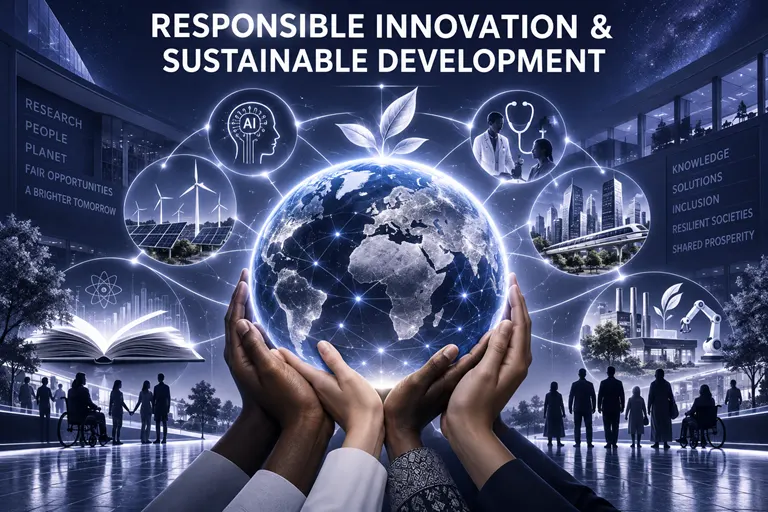
A technology that improves productivity but displaces vulnerable workers without adequate support may deepen inequality. A digital health platform that performs well in a controlled study may have limited value if rural communities cannot access it. A clean-energy project may reduce carbon emissions while creating land-use conflicts or excluding local communities from its benefits.
Responsible innovation asks researchers, institutions, businesses and governments to consider these effects before, during and after developing a new solution.
Sustainable development similarly requires an integrated approach. Environmental protection cannot be separated from economic opportunity, public health, education, equality and effective institutions. The United Nations Sustainable Development Goals demonstrate how progress in one area can influence outcomes across many others.
For the Intellecta International Journal of Research and Innovation (IIJRI), responsible innovation and sustainable development represent an important multidisciplinary field. Research in this area can connect science, engineering, healthcare, education, management, economics, public policy and the social sciences.
This article examines the principles of responsible innovation, identifies high-priority research areas and proposes a framework through which universities and research institutions can contribute to a more inclusive and sustainable future.
What Is Responsible Innovation?
Responsible innovation is an approach to research and development that considers the intended and unintended effects of innovation on society and the environment.
It asks several fundamental questions:
- Which problem is the innovation intended to solve?
- Who defined the problem?
- Who is likely to benefit?
- Who may be excluded or harmed?
- What environmental resources will be consumed?
- How will risks be identified and managed?
- Can affected communities participate in decision-making?
- What happens if the technology is misused?
- How will outcomes be monitored?
- Who remains accountable after implementation?
Responsible innovation does not mean avoiding uncertainty or preventing technological development. All meaningful innovation involves some degree of uncertainty.
Instead, it requires a deliberate process of anticipation, inclusion, reflection and responsiveness. Innovators should examine possible consequences, involve relevant stakeholders, evaluate their assumptions and modify the project when evidence reveals new risks or needs.
How Responsible Innovation Supports Sustainable Development
Sustainable development seeks to meet present needs without undermining the ability of future generations to meet their own needs. It brings together environmental, social and economic priorities.
Responsible innovation provides a practical way to apply this principle to research and technology.
For example:
- Renewable-energy research can consider affordability and community participation.
- Artificial-intelligence research can incorporate fairness, transparency and privacy.
- Agricultural innovation can balance productivity with soil, water and biodiversity protection.
- Industrial research can measure resource consumption and worker well-being.
- Healthcare innovation can address access, cultural suitability and clinical safety.
- Educational technology can evaluate learning outcomes and the digital divide.
This integration is necessary because innovations often create effects outside the sector in which they were developed.
Core Principles of Responsible Innovation
Anticipation
Researchers should investigate possible benefits, risks and unintended consequences before large-scale implementation.
Anticipation is not an attempt to predict the future with certainty. It is a structured effort to ask what could happen under different conditions.
Useful methods include:
- Scenario planning.
- Risk assessment.
- Technology assessment.
- Life-cycle analysis.
- Environmental-impact assessment.
- Social-impact assessment.
- Foresight studies.
- Pilot testing.
- Stakeholder consultation.
Researchers should examine both direct and indirect effects. An electric vehicle, for example, may reduce local emissions, but its wider environmental value also depends on electricity sources, battery materials, manufacturing and disposal.
Inclusion
The people affected by an innovation should have meaningful opportunities to influence its design and implementation.
Inclusion may involve:
- Local communities.
- Women and marginalised groups.
- Persons with disabilities.
- Workers.
- Patients.
- Students and teachers.
- Small businesses.
- Indigenous and traditional-knowledge holders.
- Policymakers.
- Civil-society organisations.
- Technical experts.
Participation should occur early enough to change the project. Asking stakeholders to approve a nearly completed solution is not meaningful co-design.
Reflection
Researchers and institutions should examine their assumptions, values and interests.
Important questions include:
- Are we defining the problem too narrowly?
- Does the project prioritise technical performance over human experience?
- Are commercial or institutional interests influencing the research?
- Is the available data representative?
- Are we overlooking local knowledge?
- Could another type of intervention solve the problem more effectively?
Reflection improves research quality by making hidden assumptions visible.
Responsiveness
Responsible research must be capable of changing direction when new evidence emerges.
If testing reveals bias, environmental harm or low community acceptance, the research team should revise the design rather than treating these findings as obstacles to commercialisation.
Responsiveness may involve:
- Modifying the technology.
- Changing implementation methods.
- Introducing safeguards.
- Collecting additional evidence.
- Delaying deployment.
- Limiting certain uses.
- Abandoning a harmful approach.
The willingness to change is a central feature of responsible innovation.
Research Priority 1: Responsible Artificial Intelligence
Artificial intelligence is influencing healthcare, education, finance, agriculture, public administration, research and industry. Its rapid development creates significant opportunities, but also raises questions about accountability, bias, privacy and human autonomy.
UNESCO’s framework for the ethics of artificial intelligence emphasises human rights, fairness, transparency, accountability and human oversight. These principles are increasingly relevant to both AI research and practical deployment.
Fairness and Algorithmic Bias
AI systems learn from data. If those data reflect historical inequalities or exclude certain populations, the resulting system may reproduce or intensify unfair outcomes.
Research priorities include:
- Measuring bias across demographic groups.
- Improving the representativeness of datasets.
- Developing context-sensitive fairness measures.
- Auditing high-impact AI systems.
- Evaluating outcomes after deployment.
- Creating practical routes for appeal and correction.
Fairness cannot always be reduced to a single technical metric. Researchers must consider the social and institutional context in which a system is used.
Explainability and Human Oversight
When AI contributes to decisions in healthcare, employment, education, finance or public services, affected people should be able to understand how the system influences the outcome.
Important research questions include:
- What level of explanation is meaningful to users?
- How can professionals challenge an automated recommendation?
- When should human judgement override a model?
- Who is accountable for errors?
- How should uncertainty be communicated?
Human oversight must be substantive rather than symbolic. A person cannot provide effective oversight if the system is too complex to understand or if organisational pressure prevents disagreement with its output.
Environmental Cost of AI
AI systems require computing infrastructure, electricity, cooling and physical hardware. Research into AI sustainability should measure:
- Energy consumption.
- Carbon emissions.
- Water use.
- Hardware life cycle.
- Electronic waste.
- Efficiency of model training and operation.
- Benefits relative to environmental cost.
Smaller, specialised models may sometimes provide sufficient performance with lower resource requirements.
Research Priority 2: Climate Adaptation and Community Resilience
Climate research must address both mitigation and adaptation. Reducing emissions remains essential, but communities also need evidence-based strategies for managing heat, water scarcity, extreme weather, disease risks and livelihood disruption.
Locally Relevant Adaptation
Climate effects differ by geography, infrastructure, income and social conditions. Research should therefore avoid assuming that a solution developed for one region will transfer automatically to another.
Priority areas include:
- Heat-resilient cities.
- Flood and drought management.
- Climate-resilient housing.
- Early-warning systems.
- Water conservation.
- Climate-smart agriculture.
- Coastal protection.
- Disaster-resistant infrastructure.
- Climate-related public-health planning.
Local residents should participate in identifying risks and evaluating possible responses.
Climate Justice
The communities contributing least to climate change may face some of its most serious consequences. Climate-justice research examines how costs, risks and benefits are distributed.
Questions include:
- Which communities are most exposed?
- Who can afford adaptation?
- How should climate finance be allocated?
- Are relocation and reconstruction policies fair?
- Do clean-energy projects respect local rights?
- How are informal workers and settlements considered?
Technical effectiveness should not be separated from procedural and distributive fairness.
Research Priority 3: Circular Economy and Resource Responsibility
Traditional economic systems often follow a linear pattern in which resources are extracted, transformed, consumed and discarded. Circular-economy research explores how materials and products can remain useful for longer.
Sustainable Product Design
Researchers can investigate products designed for:
- Durability.
- Repair.
- Reuse.
- Remanufacturing.
- Modular replacement.
- Recycling.
- Reduced material use.
- Safer components.
Design choices influence environmental impact long before a product reaches the consumer.
Waste as a Resource
Industrial, agricultural and household waste streams may provide materials for new products. Potential research areas include:
- Agricultural-residue applications.
- Construction-material recovery.
- Plastic alternatives.
- Wastewater reuse.
- Electronic-waste recovery.
- Industrial symbiosis.
- Composting and biological conversion.
- Textile reuse.
Studies must evaluate whether the recovery process creates genuine environmental benefits after energy, transportation and processing requirements are considered.
Measuring Circularity
Circularity claims require credible measurement. Research should distinguish between:
- Material reuse.
- Recyclability.
- Actual recycling rates.
- Product lifespan.
- Waste reduction.
- Carbon reduction.
- Displacement of new resource extraction.
A product labelled recyclable may still enter landfill if suitable collection and processing infrastructure does not exist.
Research Priority 4: Inclusive Healthcare Innovation
Healthcare innovation should improve health outcomes without widening existing disparities.
Digital Health Access
Telemedicine, mobile-health applications and remote monitoring can expand access, particularly in underserved regions. However, their effectiveness depends on:
- Connectivity.
- Device access.
- Digital literacy.
- Language.
- Disability accessibility.
- Privacy.
- Clinical integration.
- Affordability.
- Trust.
Research should measure who uses a digital service, who stops using it and who was never able to access it.
Representative Health Data
Clinical and AI-supported health systems require data that represent the populations in which they will be used.
Research priorities include:
- Validation across demographic groups.
- Inclusion of rural populations.
- Gender-responsive healthcare research.
- Representation of rare and neglected conditions.
- Responsible use of genetic information.
- Community governance of sensitive data.
- Bias in diagnostic algorithms.
An accurate average result can conceal poor performance for specific groups.
Low-Cost and Frugal Healthcare Innovation
Innovation does not always require complex equipment. Frugal innovation seeks safe, effective and affordable solutions suited to resource-constrained settings.
Research may focus on:
- Portable diagnostics.
- Low-cost medical devices.
- Community health systems.
- Simplified clinical workflows.
- Locally manufactured equipment.
- Accessible rehabilitation tools.
- Affordable maternal and child health interventions.
Frugal should not mean lower safety or weaker evidence. Cost reduction must be combined with quality and reliability.
Research Priority 5: Inclusive Education and Digital Equity
Educational technology can support personalised learning, translation, accessibility and teacher development. It can also deepen inequality when some students lack devices, connectivity or digital support.
Human-Centred Educational Technology
Research should begin with learning needs rather than the availability of a new tool.
Important questions include:
- Does the technology improve understanding?
- Does it support or distract from teaching?
- Can learners with disabilities use it?
- Is it suitable for different languages?
- Does it protect student information?
- Can schools maintain it?
- Does it support critical thinking?
- Are teachers involved in its design?
The success of an educational platform should be measured through learning and inclusion, not only registrations or usage time.
Responsible AI in Education
Generative AI is influencing assessment, writing, tutoring and academic work.
Priority areas include:
- AI literacy.
- Academic integrity.
- Assessment redesign.
- Teacher training.
- Student privacy.
- Bias in automated evaluation.
- Effects on critical thinking.
- Responsible disclosure.
- Equitable access.
Educational institutions require evidence-based policies that distinguish legitimate assistance from work that misrepresents a learner’s knowledge.
Lifelong Learning and Just Transitions
Technological and environmental transitions are changing work. Education systems need flexible approaches to reskilling and continuing professional development.
Research should examine how workers can acquire new capabilities without being excluded because of age, income, location or prior educational opportunity.
Research Priority 6: Sustainable and Human-Centred Industry
Industrial innovation has traditionally emphasised productivity, cost and speed. Responsible industrial research should also consider environmental performance, worker safety, resilience and job quality.
Human-Machine Collaboration
Automation and robotics can reduce dangerous or repetitive work, but they may also create surveillance, deskilling or displacement.
Research priorities include:
- Safe human-robot interaction.
- Fair allocation of tasks.
- Worker participation in automation.
- Reskilling.
- Ergonomic design.
- Effects on mental health.
- Accountability for automated decisions.
- Job quality after technological change.
Workers should be treated as participants in industrial transformation rather than as obstacles to efficiency.
Sustainable Manufacturing
Research can support:
- Energy-efficient production.
- Low-carbon materials.
- Water-efficient processes.
- Predictive maintenance.
- Cleaner supply chains.
- Waste-heat recovery.
- Local manufacturing.
- Renewable-energy integration.
- Product life-cycle assessment.
Productivity gains should be evaluated alongside environmental and social outcomes.
Responsible Supply Chains
Supply-chain research should consider:
- Labour conditions.
- Human rights.
- Environmental compliance.
- Material traceability.
- Community effects.
- Disruption resilience.
- Supplier inclusion.
- Cybersecurity.
- Verification of sustainability claims.
Digital traceability can improve transparency, but it depends on accurate data and accountable governance.
Research Priority 7: Sustainable Agriculture and Food Systems
Food systems connect environmental health, nutrition, livelihoods, trade and culture.
Climate-Resilient Agriculture
Research opportunities include:
- Drought-resistant crops.
- Soil-health improvement.
- Efficient irrigation.
- Integrated pest management.
- Agroforestry.
- Weather-informed farming.
- Crop diversification.
- Reduction of post-harvest losses.
Technological solutions should be evaluated under real farming conditions and across different landholding sizes.
Smallholder Inclusion
Small farmers may lack access to credit, equipment, markets or digital services. Innovations designed only for large commercial farms may intensify inequality.
Research should examine affordability, local repair, language accessibility, training and community ownership.
Sustainable Nutrition
Food research should consider nutrition, affordability, cultural acceptability and environmental impact together.
A sustainable food system should support healthy diets without transferring excessive environmental or economic costs to vulnerable groups.
Research Priority 8: Sustainable Cities and Inclusive Infrastructure
Cities concentrate people, economic activity, energy use and environmental risk. Urban innovation must account for the needs of diverse residents.
Priority areas include:
- Affordable and climate-resilient housing.
- Accessible public transportation.
- Clean air.
- Urban water management.
- Waste reduction.
- Renewable energy.
- Safe public spaces.
- Digital public infrastructure.
- Disability-inclusive design.
- Protection of informal workers and settlements.
Smart Cities and Data Governance
Smart-city technologies can support traffic management, energy efficiency and public services. They can also create privacy and surveillance concerns.
Research should examine:
- Data ownership.
- Public consent.
- Cybersecurity.
- Algorithmic accountability.
- Access to digital services.
- Effects on marginalised neighbourhoods.
- Procurement transparency.
- Long-term maintenance.
A city is not inclusive merely because it is digitally connected.
Research Priority 9: Social Innovation and Institutional Capacity
Many sustainability challenges cannot be solved through technology alone. They also require new organisational, financial and governance arrangements.
Social innovation may include:
- Community-owned energy.
- Cooperative enterprises.
- Inclusive finance.
- Participatory budgeting.
- New public-service models.
- Local circular-economy networks.
- Community health initiatives.
- Open educational resources.
- Citizen-science programmes.
Research should examine not only whether these models work but also the conditions required for durability and scale.
Institutional capacity is equally important. A technically effective project may fail if the responsible organisation lacks trained personnel, stable funding, public trust or appropriate governance.
Research Priority 10: Open Science and Equitable Knowledge Access
Sustainable development depends on the availability and responsible use of knowledge.
UNESCO’s Recommendation on Open Science encourages more accessible, transparent and collaborative research while recognising the need for appropriate safeguards.
Open-science practices may include:
- Open-access publishing.
- Data sharing.
- Open-source tools.
- Pre-registration.
- Reproducible methods.
- Open educational resources.
- Citizen participation.
- Accessible research summaries.
- Shared infrastructure.
However, openness must be implemented responsibly. Sensitive health, community or personal data may require controlled access. Traditional and Indigenous knowledge should not be extracted or commercialised without appropriate consent and benefit sharing.
Equitable access also requires attention to language, disability, connectivity and the costs of participating in research publication.
How Universities Can Promote Responsible Innovation
Universities play a central role because they educate future professionals, conduct research and connect with industry, government and communities.
Embed Responsibility in Research Design
Grant proposals and ethics processes can require researchers to consider:
- Intended beneficiaries.
- Possible harms.
- Environmental impact.
- Accessibility.
- Data governance.
- Community participation.
- Long-term implementation.
- Conflicts of interest.
Support Interdisciplinary Teams
Responsible innovation often requires technical and social expertise. An AI healthcare project, for example, may need clinicians, data scientists, ethicists, legal researchers and patient representatives.
Recognise Social and Environmental Impact
Promotion and funding systems should recognise:
- Policy contribution.
- Community engagement.
- Open research resources.
- Sustainable technology development.
- Professional-practice improvement.
- Responsible commercialisation.
- Public communication.
Create Living Laboratories
A living laboratory tests innovation in a real environment with users and stakeholders. Universities can use campuses, hospitals, communities and industry partnerships to study actual implementation.
Teach Responsible Innovation
Students in engineering, science, medicine, business and computing should learn how ethical, environmental and social considerations relate to professional decision-making.
A Responsible Innovation Research Framework
Researchers can use the following framework when planning a project.
Step 1: Define the Real Problem
Describe the social, environmental or economic challenge before proposing a particular technology.
Step 2: Identify Affected Groups
Determine who may benefit, who may be excluded and who may bear the risks.
Step 3: Build an Interdisciplinary Team
Include the expertise required to examine technical performance, human behaviour, ethics, economics and implementation.
Step 4: Engage Stakeholders
Consult users, communities, practitioners and policymakers early enough for their input to influence the design.
Step 5: Assess Alternatives
Compare the proposed innovation with lower-cost, non-technological or community-based approaches.
Step 6: Evaluate the Full Life Cycle
Consider materials, energy, production, use, maintenance and end-of-life impacts.
Step 7: Test in Real Conditions
Pilot the innovation with representative users and realistic operational constraints.
Step 8: Monitor Intended and Unintended Outcomes
Measure social and environmental effects alongside technical performance.
Step 9: Respond to Evidence
Modify, restrict or discontinue the innovation if evidence reveals unacceptable risks.
Step 10: Communicate Transparently
Report methods, limitations, conflicts of interest, negative findings and uncertainty.
Measuring Responsible Innovation
Responsible innovation needs measurable indicators. Depending on the project, evaluation may include:
Environmental Indicators
- Energy consumption.
- Greenhouse-gas emissions.
- Water use.
- Waste generation.
- Material recovery.
- Biodiversity effects.
- Product lifespan.
Social Indicators
- Accessibility.
- Affordability.
- Participation.
- Gender equity.
- Disability inclusion.
- Employment quality.
- Community acceptance.
- Distribution of benefits.
Governance Indicators
- Transparency.
- Data protection.
- Accountability.
- Stakeholder representation.
- Grievance mechanisms.
- Conflict-of-interest disclosure.
- Independent oversight.
Economic Indicators
- Total cost.
- Long-term maintenance.
- Local employment.
- Productivity.
- Scalability.
- Benefits for small enterprises.
- Financial accessibility.
An innovation should not be declared sustainable on the basis of a single favourable indicator.
Frequently Asked Questions
What is responsible innovation?
Responsible innovation is a research and development approach that anticipates possible consequences, includes affected stakeholders, reflects on values and assumptions, and responds to evidence about social, ethical and environmental effects.
How is responsible innovation connected with sustainable development?
Responsible innovation helps ensure that new technologies and practices support environmental protection, social inclusion and long-term economic well-being rather than solving one problem while creating another.
What are the main research priorities for sustainable development?
Major priorities include responsible AI, climate resilience, circular systems, clean energy, inclusive healthcare, digital equity, sustainable agriculture, human-centred industry, resilient cities and equitable knowledge access.
Why is inclusion important in innovation research?
An innovation may perform well technically but fail in practice if it overlooks affordability, language, disability, culture, infrastructure or community priorities. Inclusion improves relevance, fairness and adoption.
What is responsible artificial intelligence?
Responsible AI is designed and used with attention to fairness, transparency, privacy, security, human oversight and accountability. It also considers the social and environmental effects of AI infrastructure.
How can researchers measure whether an innovation is sustainable?
Researchers should evaluate environmental, social, economic and governance indicators across the full life cycle of the innovation. They should also compare expected benefits with unintended consequences.
What role do universities play in responsible innovation?
Universities can develop interdisciplinary research, involve communities, train students, support ethical commercialisation, provide independent evidence and connect research with policy and professional practice.
Can commercial innovation also be socially responsible?
Yes. Commercial success and public value can coexist when products are safe, accessible, environmentally responsible and governed transparently. Responsible commercialisation requires ongoing accountability.
What is the difference between social innovation and technological innovation?
Technological innovation usually involves new tools, products or processes. Social innovation develops new organisational or community-based approaches to social needs. Many effective solutions combine both.
Why is open science relevant to sustainable development?
Open science can improve access, collaboration, transparency and reuse of knowledge. It must still protect privacy, confidential information and community or traditional knowledge.
What types of responsible-innovation studies can be submitted to IIJRI?
IIJRI can provide a platform for original research, reviews, case studies, policy analyses and technical studies examining responsible AI, sustainability, healthcare, education, industry, climate resilience, social innovation and related multidisciplinary topics.
Conclusion
Innovation will play an important role in addressing climate change, public-health challenges, educational inequality, resource scarcity and industrial transformation. Yet innovation alone does not guarantee a more sustainable or inclusive future.
The direction of innovation matters. So do the people involved in designing it, the evidence used to evaluate it and the institutions responsible for its consequences.
Responsible innovation requires researchers to anticipate risks, involve affected communities, examine underlying assumptions and respond when evidence reveals harm or exclusion. Sustainable development requires environmental, social and economic priorities to be considered together.
The most valuable future research will therefore move beyond asking whether a technology can be developed. It will also ask whether the innovation is necessary, accessible, fair, maintainable and environmentally responsible.
The Intellecta International Journal of Research and Innovation supports multidisciplinary scholarship that connects research with practical and social value. Researchers examining sustainability, responsible technology, inclusive development and evidence-based innovation are encouraged to contribute original and rigorous work to IIJRI.
By publishing transparent, context-sensitive and socially relevant research, academic journals can help ensure that innovation serves not only technological progress but also human dignity, environmental resilience and shared prosperity.
Publishing-support note: Universities, societies and research institutions planning to launch or modernise scholarly journals may obtain support for ScholarJMS journal websites and editorial workflows, OJS hosting or migration through OJSCloud, ISSN-readiness consulting, Crossref DOI guidance through GetDOI, and transparent peer-review infrastructure through Scholar9. For guidance, contact WhatsApp: +91 82003 85143 or inquiry@ojscloud.com.