
Emerging Multidisciplinary Research and Innovation Trends in 2026: AI, Sustainability, Healthcare, Education and Industry
Research in 2026 is increasingly shaped by problems that cannot be understood or solved within the boundaries of a single discipline. Artificial intelligence is changing scientific discovery, healthcare, education and industrial production. Climate change is influencing public health, infrastructure, agriculture, technology and economic policy. Digital platforms are creating new opportunities for learning and collaboration while also raising important questions about privacy, equity and human agency.
The most significant research opportunities are therefore emerging at the intersections between disciplines.
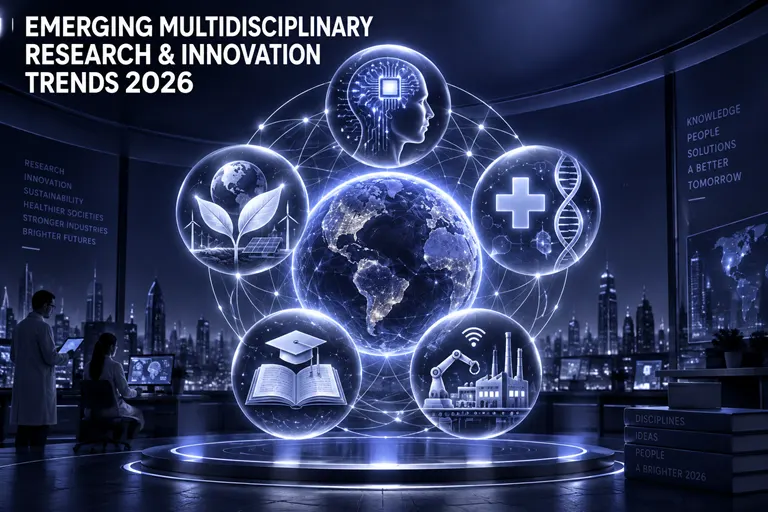
Computer scientists are working with clinicians to improve medical decision support. Environmental researchers are collaborating with engineers and economists to design climate-resilient systems. Education specialists are examining how artificial intelligence affects assessment, accessibility and critical thinking. Industrial researchers are integrating automation with sustainability, workforce development and responsible governance.
For the Intellecta International Journal of Research and Innovation (IIJRI), these developments are especially relevant. As a multidisciplinary, peer-reviewed and open-access journal, IIJRI provides a platform for research that connects theoretical knowledge with practical applications and encourages collaboration across academic and professional fields.
This article examines five influential areas shaping multidisciplinary research in 2026: artificial intelligence, sustainability, healthcare, education and industry. It also identifies the methodological, ethical and institutional changes researchers must consider when designing studies for a rapidly evolving world.
Why Multidisciplinary Research Matters in 2026
Many contemporary challenges are systems problems. They involve interacting technological, environmental, economic, behavioural, cultural and institutional factors.
Improving urban air quality, for example, may require environmental monitoring, public-health analysis, transportation engineering, data science, behavioural research and municipal policy. A technically effective solution may still fail if it is unaffordable, socially unacceptable or poorly governed.
Multidisciplinary research brings different forms of expertise to the same problem. Interdisciplinary research goes further by integrating concepts, methods or theories from several disciplines to produce a more unified explanation or solution.
The growing importance of these approaches reflects several realities:
- Research problems are becoming more complex and interconnected.
- Digital technologies generate data that can be studied across disciplinary contexts.
- Governments and industries increasingly expect research to demonstrate practical or social value.
- Climate, health and development challenges require coordinated responses.
- Innovation frequently occurs when knowledge moves between previously separate fields.
- Researchers must consider not only whether a solution works, but also for whom, under what conditions and with what consequences.
Strong multidisciplinary research is not created simply by placing researchers from different departments in the same project. It requires shared research questions, compatible methods, clear terminology and a common understanding of impact.
Trend 1: Artificial Intelligence as Research Infrastructure
Artificial intelligence is moving beyond being an isolated computer-science topic. It is becoming part of the infrastructure through which research is planned, conducted, analysed and communicated.
Researchers now use AI-assisted tools for literature discovery, data classification, pattern recognition, modelling, image analysis, language processing and decision support. Generative AI can assist with preliminary idea exploration and the organisation of complex information, while machine-learning systems can identify relationships within large datasets that would be difficult to detect manually.
This creates opportunities across disciplines, but it also changes the questions researchers must ask.
AI-Augmented Scientific Discovery
AI-supported research is becoming particularly important in fields that produce large or complex datasets. Potential applications include:
- Analysing medical images and clinical records.
- Modelling climate and environmental change.
- Predicting material properties.
- Supporting drug and molecule discovery.
- Detecting patterns in agricultural and satellite data.
- Examining consumer and organisational behaviour.
- Processing multilingual social-science data.
- Simulating industrial processes.
- Identifying relationships within large scholarly databases.
The central research opportunity is not merely automation. It is augmentation. Researchers can use computational tools to extend human analytical capacity while retaining responsibility for interpretation, contextual understanding and ethical judgement.
Explainability, Reliability and Reproducibility
An AI system may produce an accurate prediction without providing a sufficiently clear explanation of how that prediction was reached. This can be problematic in healthcare, education, finance, public administration and other fields where decisions affect individuals or communities.
Important research questions for 2026 include:
- How can AI models be made more explainable to non-technical users?
- How should algorithmic performance be tested across different populations?
- What forms of documentation are required to reproduce AI-supported research?
- How can researchers identify fabricated, incomplete or biased outputs?
- When should human review override automated recommendations?
- How should AI use be disclosed in research and publication?
UNESCO’s global framework for the ethics of artificial intelligence emphasises human rights, transparency, fairness and human oversight. These principles are becoming increasingly relevant to research design, not only to the commercial deployment of AI.
Smaller, Context-Specific AI Systems
Research attention is also moving towards smaller and more specialised models. A context-specific model trained or adapted for a hospital, university, language community, manufacturing process or agricultural region may sometimes be more practical than a general-purpose system.
These models can offer advantages in cost, privacy, local relevance and interpretability. However, they require careful validation. A system developed in one institutional or cultural environment may not perform equally well elsewhere.
Consequently, locally grounded AI research is likely to become an important multidisciplinary priority.
Trend 2: Sustainability Moving from Principle to Measurable Practice
Sustainability research is expanding beyond broad commitments towards measurable interventions, verified outcomes and context-sensitive implementation.
The United Nations’ sustainable-development framework illustrates how environmental goals are connected with health, education, inequality, infrastructure, employment and institutional capacity. Research in 2026 increasingly reflects these relationships.
Climate Adaptation and Resilience
Climate research is no longer concerned only with estimating future environmental change. There is growing demand for studies that help communities, institutions and industries adapt to changes already taking place.
Relevant research areas include:
- Climate-resilient agriculture and food systems.
- Heat-health risk and urban planning.
- Water conservation and wastewater reuse.
- Disaster preparedness and early-warning systems.
- Resilient buildings and public infrastructure.
- Supply-chain vulnerability.
- Community-based adaptation.
- Climate migration and social protection.
- Insurance and financial resilience.
These topics require the combined knowledge of environmental science, engineering, public health, economics, sociology, geography and governance.
A technically successful intervention must also be locally acceptable, financially realistic and accessible to vulnerable groups. Researchers therefore need to assess not only environmental performance but also adoption, equity and long-term maintenance.
Circular Economy and Sustainable Production
The circular economy seeks to reduce waste by extending product life, reusing materials and designing systems that recover value from resources.
In 2026, promising research questions include:
- How can products be designed for repair, reuse or recycling?
- Can industrial by-products become useful materials?
- How can digital tracking improve supply-chain transparency?
- Which incentives encourage consumers and businesses to adopt circular practices?
- How should the environmental impact of circular products be measured?
- Can local manufacturing reduce material and transportation costs?
Life-cycle assessment, materials science, product design, management research and public policy all contribute to this area.
Research must also distinguish genuine sustainability improvements from claims that merely shift environmental costs from one stage of production to another.
Clean Energy and Intelligent Resource Management
Renewable energy research increasingly intersects with data science, energy storage, public policy and consumer behaviour. The transition to cleaner energy systems depends not only on generation technologies but also on grid stability, affordability, storage, demand management and public acceptance.
AI-supported forecasting may improve the balancing of energy supply and demand. Smart sensors can assist with building efficiency, water management and industrial maintenance. However, digital systems also consume energy and require physical infrastructure.
This creates an important research principle: digital innovation should be evaluated for its own environmental footprint, not automatically treated as sustainable.
Trend 3: Healthcare Becoming Predictive, Connected and Patient-Centred
Healthcare innovation in 2026 is being shaped by the convergence of medicine, public health, engineering, data science, behavioural research and digital communication.
The World Health Organization identifies evidence-based implementation, interoperability and responsible data use as central considerations in digital health. The global research challenge is to translate technological possibility into safe, equitable and clinically meaningful outcomes.
AI-Assisted Diagnosis and Clinical Decision Support
AI systems are being studied for medical imaging, risk prediction, clinical documentation, patient monitoring and decision support. These applications may assist healthcare professionals by organising data, detecting patterns and identifying cases requiring closer attention.
However, accuracy alone is not sufficient.
Healthcare AI research must examine:
- Clinical validity across diverse patient groups.
- False-positive and false-negative results.
- Integration with professional workflows.
- Patient consent and data privacy.
- Accountability for AI-supported decisions.
- Effects on clinician-patient relationships.
- Accessibility in low-resource environments.
- Bias arising from unrepresentative datasets.
WHO guidance on AI for health stresses ethics, trust and appropriate governance. In practical terms, researchers should evaluate how a system performs in real clinical environments rather than relying exclusively on laboratory or retrospective results.
Personalised and Preventive Healthcare
Wearable devices, remote-monitoring tools and connected health records are supporting research into earlier and more personalised interventions.
Potential studies may investigate whether digital systems can improve:
- Management of diabetes and cardiovascular conditions.
- Medication adherence.
- Maternal and child health.
- Mental-health support.
- Rehabilitation and post-operative monitoring.
- Detection of disease risk.
- Preventive health behaviour.
- Healthcare access in remote communities.
The strongest studies will combine technical performance with clinical relevance, behavioural adoption and health-equity analysis.
A device may collect accurate data but still have limited value if patients cannot afford it, clinicians cannot interpret its alerts or healthcare institutions lack the capacity to respond.
One Health and Integrated Public Health Research
The One Health approach recognises that human, animal and environmental health are closely connected. Antimicrobial resistance, emerging infections, food safety, biodiversity loss and climate-sensitive diseases cannot be addressed through human medicine alone.
Research opportunities include:
- Surveillance systems combining veterinary and human-health information.
- Environmental drivers of infectious diseases.
- Responsible antibiotic use.
- Food-system resilience.
- Zoonotic-disease prevention.
- Climate change and disease distribution.
- Community communication during public-health emergencies.
This is a clear example of why multidisciplinary research is essential. Effective solutions require laboratory science, epidemiology, veterinary medicine, environmental monitoring, behavioural research and public policy.
Trend 4: Education Moving Towards Human-Centred Digital Transformation
Education research in 2026 is increasingly focused on how technology can improve learning without weakening human judgement, inclusion or academic integrity.
AI can support personalised learning, translation, accessibility, formative feedback and administrative planning. At the same time, it may intensify inequality, enable academic misconduct, weaken independent thinking or expose sensitive learner data.
UNESCO’s work on AI in education advocates a human-centred and rights-based approach. This means educational technology should support learners and teachers rather than treating automation as the main objective.
AI Literacy as a Core Academic Capability
AI literacy involves more than knowing how to operate a tool. Learners and researchers must understand how AI systems generate outputs, where errors may arise and when information requires independent verification.
Important components include:
- Critical evaluation of AI-generated information.
- Recognition of algorithmic bias.
- Responsible disclosure of AI assistance.
- Data and privacy awareness.
- Source verification.
- Understanding intellectual-property concerns.
- Retaining independent reasoning and subject knowledge.
Research is needed to determine which AI-literacy approaches work across different disciplines, age groups and educational settings.
Rethinking Assessment and Academic Integrity
Traditional assignments may not reliably demonstrate individual learning when generative AI can produce fluent responses. Educational institutions are therefore reconsidering assessment design.
Promising research areas include:
- Oral assessment and research defence.
- Project-based and problem-based learning.
- Reflective documentation of the learning process.
- Authentic assessments based on local contexts.
- Version histories and research journals.
- Collaborative assessment.
- Transparent policies for acceptable AI use.
The objective should not be to prohibit every use of technology. It should be to design assessment that measures understanding, judgement, application and originality.
Inclusive and Accessible Learning
Digital tools may improve access for learners with disabilities, speakers of different languages and students in geographically remote locations. Yet unequal access to devices, connectivity and digital skills can deepen existing educational gaps.
Research should therefore examine who benefits, who is excluded and what forms of institutional support are required.
The future of education will depend on combining technological capability with pedagogy, accessibility, teacher development and learner well-being.
Trend 5: Industry 5.0, Intelligent Manufacturing and Human-Machine Collaboration
Industrial research is moving beyond automation for efficiency alone. Greater attention is being given to resilience, sustainability, customisation and the relationship between people and intelligent machines.
This direction is sometimes described as Industry 5.0, with an emphasis on human-centred, sustainable and resilient production.
Digital Twins and Predictive Systems
A digital twin is a virtual representation of a physical product, process or system. When connected with real-time data, it can support simulation, monitoring and predictive maintenance.
Research opportunities include:
- Smart manufacturing.
- Energy-efficient factories.
- Infrastructure monitoring.
- Supply-chain simulation.
- Equipment-failure prediction.
- Urban and transportation planning.
- Healthcare-system capacity modelling.
- Agricultural-process optimisation.
Digital-twin research requires collaboration between engineering, computing, operations management and domain specialists. Researchers must also consider data quality, cybersecurity, interoperability and implementation costs.
Human-Machine Collaboration
The future of work is unlikely to be defined only by humans being replaced by machines. In many settings, the more relevant question is how tasks should be divided between human judgement and automated capability.
The World Economic Forum’s Future of Jobs Report 2025 identifies technological change and the green transition as major forces reshaping employment and skills. It also indicates that technology-related capabilities must be combined with analytical thinking, creativity, resilience, leadership and collaboration.
Research priorities include:
- Designing safe and understandable human-machine interfaces.
- Measuring the effects of automation on work quality.
- Identifying effective reskilling models.
- Preventing workplace surveillance and discrimination.
- Supporting small and medium-sized enterprises.
- Evaluating productivity alongside worker well-being.
- Understanding how AI changes professional responsibility.
An industrial system should not be considered innovative merely because it uses AI. Innovation should be assessed through measurable improvements in safety, sustainability, quality, resilience and human outcomes.
Resilient and Transparent Supply Chains
Recent disruptions have increased interest in supply-chain resilience. Organisations are exploring real-time monitoring, local production, alternative sourcing and predictive analytics.
Research in this area can connect logistics, economics, climate science, cybersecurity, labour studies and international policy.
Transparency is particularly important. Digital traceability systems may help verify product origins, working conditions and environmental claims, but their usefulness depends on accurate data and trustworthy governance.
Cross-Cutting Priorities for Researchers in 2026
The five trends discussed above share several common research requirements.
Responsible Data Governance
Researchers must explain how data are collected, stored, shared and protected. Sensitive information should be handled with appropriate consent, security and oversight.
Data governance is especially important when research crosses institutions, countries or disciplinary traditions with different ethical expectations.
Reproducibility and Transparent Methods
Multidisciplinary studies should document data sources, analytical decisions, software, model limitations and conflicts of interest. When AI tools contribute materially to the research process, their role should be disclosed according to relevant journal and institutional policies.
Transparency enables readers to evaluate the reliability of findings.
Inclusion and Local Relevance
A solution developed for one population may not transfer successfully to another. Research should involve communities, practitioners and users where their experience is relevant to the problem being studied.
Inclusive research improves both ethical quality and practical usefulness.
Measurement of Real-World Impact
Researchers should distinguish between outputs and outcomes. Creating an application, model or prototype is an output. Demonstrating that it improves learning, health, sustainability or productivity is an outcome.
Impact assessment should include unintended consequences as well as expected benefits.
Collaboration Across Academic and Professional Boundaries
Universities, research institutes, hospitals, industries, governments and communities each hold different forms of knowledge. Collaborative research can produce more relevant findings when responsibilities, authorship, data ownership and expectations are agreed upon clearly.
Research Opportunities for Authors and Institutions
Researchers planning new studies in 2026 may consider questions such as:
- How can AI support scientific discovery without compromising transparency or human responsibility?
- Which sustainability interventions produce measurable environmental and social benefits?
- How can digital healthcare tools be validated in diverse and resource-constrained settings?
- What forms of assessment best measure student learning in AI-enabled education?
- How can industries combine automation with worker well-being and environmental responsibility?
- What governance frameworks are needed for multidisciplinary data sharing?
- How can research findings move more effectively from universities into communities, policy and industry?
- Which models of interdisciplinary collaboration produce lasting institutional capacity?
These questions can support original research articles, systematic reviews, case studies, methodological papers and policy analyses.
Frequently Asked Questions
What are the leading multidisciplinary research trends in 2026?
The leading trends include responsible artificial intelligence, climate adaptation, circular-economy systems, digital health, personalised education, Industry 5.0, human-machine collaboration, smart infrastructure and research addressing the relationship between technology and society.
Why is multidisciplinary research becoming more important?
Major problems such as climate change, public health, digital transformation and sustainable industrial development involve technical, social, economic and institutional factors. No single discipline can adequately address all these dimensions.
What is the difference between multidisciplinary and interdisciplinary research?
Multidisciplinary research brings several disciplines together while each may retain its own methods. Interdisciplinary research integrates concepts, theories or methods from different fields to develop a shared approach to a research problem.
How is artificial intelligence changing academic research?
AI can assist with information discovery, data analysis, modelling, image interpretation and pattern recognition. It also creates challenges involving bias, reliability, explainability, privacy, authorship and research integrity.
Which sustainability topics offer strong research opportunities?
High-priority areas include climate adaptation, renewable energy, water security, sustainable agriculture, resilient infrastructure, circular production, green finance, environmental justice and the measurement of sustainability outcomes.
What are the major healthcare innovation priorities?
Important priorities include clinically validated AI, digital-health interoperability, remote monitoring, personalised prevention, health-data governance, equitable access and One Health research connecting human, animal and environmental health.
How should educational institutions respond to generative AI?
Institutions need clear policies, AI-literacy education, redesigned assessment, teacher development and safeguards for privacy, accessibility and academic integrity. The goal should be responsible, human-centred use rather than uncritical adoption.
What makes multidisciplinary research suitable for publication?
Publishable multidisciplinary research should present a clear question, justify the contribution of each discipline, use appropriate and transparent methods, explain limitations and demonstrate theoretical, practical or social relevance.
Conclusion
Multidisciplinary research in 2026 is being shaped by convergence. Artificial intelligence is interacting with medicine, education, sustainability and industry. Climate priorities are influencing technology, infrastructure, health and economic policy. Digital transformation is creating new opportunities while making ethics, equity, transparency and human oversight more important.
The most valuable research will not be defined by the use of a fashionable technology alone. It will be distinguished by the clarity of its problem, the quality of its evidence, the appropriateness of its methods and its ability to create responsible real-world value.
The Intellecta International Journal of Research and Innovation provides an appropriate scholarly platform for such work. IIJRI welcomes original research, review articles, case studies and technical contributions that advance knowledge, connect disciplines and bridge academic research with practical applications.
Researchers working across artificial intelligence, sustainability, healthcare, education, industry and related fields are encouraged to review the journal’s author guidelines and consider IIJRI for the dissemination of rigorous, original and socially relevant scholarship.
Publishing-support note: Universities, scholarly societies and academic institutions planning to launch or modernise a journal may obtain support for ScholarJMS journal websites and editorial workflows, OJS hosting or migration through OJSCloud, ISSN-readiness consulting, Crossref DOI workflow guidance through GetDOI, and transparent peer-review infrastructure through Scholar9. For guidance, contact WhatsApp: +91 82003 85143 or inquiry@ojscloud.com.