
How to Build a Professional Journal Website with Online Submission, Peer Review and Article Publishing
A professional academic journal website is more than a digital homepage. It is the journal’s publishing infrastructure, editorial workspace, submission gateway, article archive and public record.
Authors use it to evaluate the journal before submitting a manuscript. Reviewers depend on it to receive assignments and provide recommendations. Editors use it to track decisions, revisions and publication stages. Readers rely on it to discover articles, verify metadata and access published research. Libraries, indexing services and search engines examine its structure to understand the journal and its content.
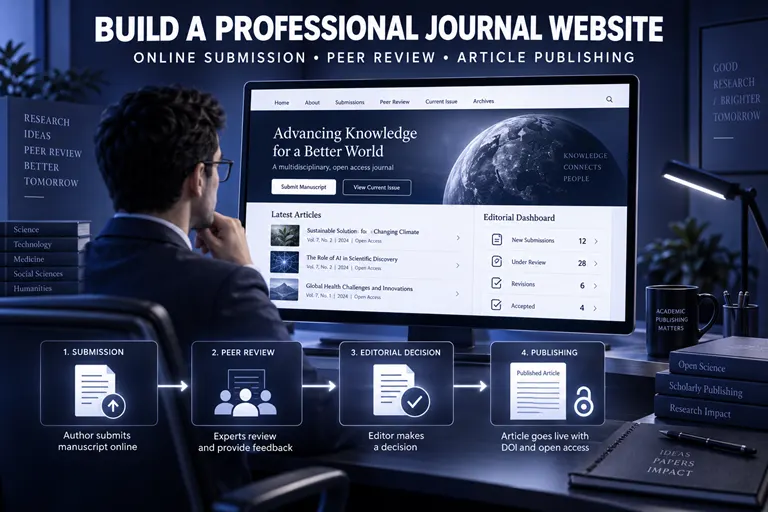
A journal may have a respected editorial board and a valuable academic mission, but an incomplete or poorly structured website can weaken its credibility. Missing policies, unclear submission procedures, inconsistent article pages and manual email-based workflows can create avoidable difficulties for authors, reviewers and editors.
For new journals, universities, scholarly societies and independent academic publishers, website development should therefore begin with a publishing strategy rather than a visual design alone.
The Intellecta International Journal of Research and Innovation (IIJRI) demonstrates the type of integrated digital presence that an emerging multidisciplinary journal requires. Its website brings together journal information, author guidance, manuscript submission, publication policies, editorial details, calls for papers and article-publishing functions through ScholarJMS.
This guide explains how to build a professional journal website with online submission, peer review, editorial management and structured article publishing. It also examines ISSN readiness, Crossref DOI workflows, discoverability, security and the long-term operational requirements of digital scholarly publishing.
Why a Journal Website Must Be More Than an Attractive Design
Visual design matters because it creates the reader’s first impression. However, academic credibility depends more heavily on the website’s information architecture, transparency and functionality.
A professional journal website should answer several questions immediately:
- What is the journal’s complete title?
- Which disciplines and research areas does it cover?
- Who publishes the journal?
- Who is responsible for editorial decisions?
- What types of manuscripts are accepted?
- How does peer review work?
- What ethical and editorial policies are followed?
- How can authors submit and track manuscripts?
- Where can readers access current and previous issues?
- Are article metadata, author details and citation information complete?
- What are the journal’s ISSN and DOI arrangements?
- How can the editorial office be contacted?
If these details are difficult to locate, researchers may hesitate to submit their work. A strong website reduces uncertainty and establishes the journal as an organised scholarly publication.
Step 1: Define the Journal Before Developing the Website
Website development should not begin until the journal’s identity and publishing model have been clearly defined.
Establish the Journal’s Academic Identity
The journal should document:
- Full journal title and approved abbreviation.
- Subject area and disciplinary focus.
- Aim and scope.
- Target author and reader groups.
- Accepted manuscript types.
- Publication frequency.
- Publishing language.
- Open-access or subscription model.
- Peer-review model.
- Publisher or owning institution.
- Editorial leadership.
- Geographic and academic positioning.
For a multidisciplinary journal such as IIJRI, the scope should be broad enough to accommodate research across fields while remaining specific about the types of contributions and academic value expected.
A vague statement claiming to publish research from every possible subject does not create a meaningful identity. The website should explain how different disciplines connect with the journal’s central mission.
Decide the Publishing Schedule
A journal should select a frequency it can maintain. Possible models include:
- Annual publication.
- Biannual publication.
- Quarterly publication.
- Monthly publication.
- Continuous article publishing.
Publication frequency should reflect editorial capacity, expected submission volume and production resources. It is better to maintain a realistic schedule consistently than to announce a frequency the journal cannot support.
Confirm Governance and Responsibilities
The publisher should define who is responsible for:
- Editorial decisions.
- Peer-review coordination.
- Technical administration.
- Copyediting and proofreading.
- Metadata preparation.
- DOI registration.
- Issue publication.
- Policy management.
- Author communication.
- Long-term preservation.
Clear responsibilities prevent manuscripts from becoming delayed between editorial stages.
Step 2: Plan the Essential Website Structure
A professional journal website should have a predictable and accessible navigation structure. Visitors should not need to search through multiple pages to find essential information.
Homepage
The homepage should communicate the journal’s identity within a few seconds. It should include:
- Journal name and logo.
- ISSN status or assigned ISSN.
- Short description of the journal.
- Main subject area.
- Publisher information.
- Submission button.
- Current issue link.
- Call for papers.
- Important notices.
- Selected or recent articles.
- Publication frequency.
- Peer-review and access model.
- Contact information.
The homepage should not be overloaded with long paragraphs, moving banners or excessive graphics. Academic users usually visit with a specific objective, such as submitting a paper, checking a policy or reading an article.
About the Journal
The About page should present the journal’s background, academic purpose, institutional ownership and publishing model. It should identify the publisher and explain the journal’s commitment to research quality.
Aims and Scope
The Aims and Scope page is one of the most important pages for authors. It helps them decide whether their manuscript is suitable.
A well-written scope should describe:
- Core academic disciplines.
- Interdisciplinary areas.
- Research problems of interest.
- Accepted methodological approaches.
- Article types.
- Intended academic and professional audience.
- Types of submissions that fall outside the journal’s scope.
Editorial Board
The Editorial Board page should include accurate information about each member, such as:
- Full name.
- Editorial role.
- Institutional affiliation.
- Country.
- Department or subject expertise.
- ORCID or institutional profile where appropriate.
Names should not be added without consent. The journal should review this page regularly to remove outdated affiliations or inactive members.
Author Guidelines
Author guidelines should explain the complete submission and preparation process. They should cover:
- Article types and word limits.
- Manuscript structure.
- Formatting requirements.
- Referencing style.
- Tables and figures.
- Supplementary files.
- Author-contribution statements.
- Conflict-of-interest declarations.
- Funding disclosures.
- Ethical approval.
- Informed consent where relevant.
- Data-availability statements.
- Use of artificial intelligence.
- Revision procedures.
- Copyright and licensing.
- Publication charges, if any.
Unclear guidelines create unnecessary editorial work because authors submit incomplete or incorrectly formatted manuscripts.
Policies and Publication Ethics
A credible journal should publish complete policies rather than displaying only general statements about quality.
Depending on its scope, the website may need policies covering:
- Peer review.
- Publication ethics.
- Plagiarism and similarity checking.
- Authorship and contributorship.
- Conflicts of interest.
- Complaints and appeals.
- Corrections, retractions and expressions of concern.
- Research involving humans or animals.
- Informed consent.
- Data sharing.
- Copyright and licensing.
- Open access.
- Article-processing charges and refunds.
- Advertising and sponsorship.
- Editorial independence.
- Artificial-intelligence use.
- Archiving and digital preservation.
- Privacy and website terms.
These policies should reflect the journal’s actual procedures. Copying policies from another publication without adapting them can create contradictions and compliance problems.
Current Issue and Archive
Every issue should have a dedicated page displaying:
- Volume and issue number.
- Publication year and date.
- Issue title where applicable.
- Cover image where used.
- Table of contents.
- Article titles.
- Author names.
- Article types.
- Page ranges or article numbers.
- DOI links.
- Full-text access.
Archives should be arranged consistently by year, volume and issue.
Contact Page
The Contact page should identify the editorial office and provide legitimate contact information. It may include the journal email, publisher address, enquiry form and official telephone or WhatsApp number.
A journal should ideally use a domain-based email address once its technical infrastructure is established.
Step 3: Implement Online Manuscript Submission
Email submission may appear simple when a journal is new, but it becomes difficult to manage as submission volume increases.
Manuscripts, declarations, reviewer comments and revised files may become scattered across inboxes. Editors may struggle to determine which version is current or whether an author has completed a required correction.
An online submission system creates a structured record for each manuscript.
What an Online Submission Form Should Collect
A complete submission workflow may collect:
- Manuscript title.
- Article type.
- Abstract.
- Keywords.
- Subject classification.
- Corresponding-author information.
- Complete co-author details.
- Institutional affiliations.
- ORCID identifiers.
- Manuscript file.
- Tables, figures and supplementary material.
- Cover letter.
- Ethical approval information.
- Conflict-of-interest statement.
- Funding information.
- Author-contribution statement.
- Suggested or opposed reviewers where permitted.
- Agreement with journal policies.
- Copyright or licensing declaration.
The system should generate a unique manuscript reference number and send an acknowledgement to the corresponding author.
Author Accounts and Manuscript Tracking
Authors should be able to log in and view the status of their submissions. Suitable status labels may include:
- Submission received.
- Initial editorial screening.
- Returned for technical correction.
- Under editor assessment.
- Reviewers invited.
- Under peer review.
- Revision requested.
- Revised manuscript received.
- Accepted.
- Rejected.
- In production.
- Published.
Status labels should be used accurately. A manuscript should not be shown as under peer review if no reviewer has accepted the assignment.
Step 4: Create a Structured Editorial Screening Process
Not every submitted manuscript should proceed directly to external review.
An initial editorial assessment can determine whether the manuscript:
- Fits the journal’s scope.
- Follows basic author guidelines.
- Contains the necessary declarations.
- Presents an identifiable scholarly contribution.
- Meets minimum language and presentation standards.
- Includes ethical approval where required.
- Shows signs of duplicate submission or serious plagiarism.
- Has suitable references, figures and supporting files.
The editorial team may then send the manuscript for review, request technical corrections or issue a desk rejection.
This stage saves reviewer time and helps maintain consistent journal standards.
Step 5: Build a Transparent Peer-Review Workflow
Peer review is not simply an exchange of files. It is a controlled process involving reviewer selection, confidentiality, deadlines, recommendations and editorial judgement.
Choose and Publish the Review Model
Common peer-review models include:
- Single-anonymous review.
- Double-anonymous review.
- Open peer review.
- Transparent peer review.
- Post-publication review.
The selected model should be explained on the website and followed consistently.
IIJRI uses a double-blind peer-review model. Under this approach, reviewer identities are normally concealed from authors, and author-identifying information should be removed from the version sent to reviewers where operationally possible.
Reviewer Selection and Conflict Checking
Editors should select reviewers with relevant subject expertise. Before accepting an assignment, reviewers should disclose potential conflicts relating to:
- Personal or professional relationships.
- Institutional connections.
- Recent collaboration.
- Financial interests.
- Direct academic competition.
- Prior knowledge of the submitted work.
A database of reviewer expertise can make assignment more efficient, but editors should still assess suitability for each manuscript.
Reviewer Tools and Forms
A reviewer dashboard should provide access to:
- The anonymised manuscript.
- Supplementary files.
- Review instructions.
- Evaluation criteria.
- Confidential comments for the editor.
- Comments for the authors.
- Recommendation options.
- Due date.
- Conflict-of-interest declaration.
Structured review forms can improve consistency while allowing space for detailed comments.
Editorial Decision Management
Reviewer recommendations inform the editor but should not automatically determine the final decision. The editor must assess the quality, relevance and consistency of the reviews.
Common decisions include:
- Accept.
- Minor revision.
- Major revision.
- Resubmit for review.
- Reject.
Decision letters should provide clear instructions and consolidate conflicting reviewer comments where necessary.
Revision Tracking
The system should retain every version of the manuscript and associated files. Authors should be able to upload:
- Revised manuscript.
- Clean manuscript.
- Tracked-changes version.
- Point-by-point response to reviewers.
- Updated declarations or supplementary files.
Version control is essential for maintaining an accurate editorial record.
Need Help Building or Upgrading Your Journal?
We support universities, societies, institutions and independent publishers with:
- ScholarJMS journal website setup.
- Online manuscript submission.
- Editorial and peer-review workflows.
- OJS hosting and technical support.
- OJS-to-ScholarJMS migration.
- ISSN consulting and website-readiness guidance.
- Crossref DOI setup and workflow support.
- Article and issue-publishing structure.
- Journal launch and publishing consultation.
WhatsApp: +91 82003 85143
Email: inquiry@ojscloud.com
Step 6: Manage Copyediting and Production
Acceptance is not the final stage of publishing. An accepted manuscript must be prepared for accurate and consistent publication.
Copyediting
Copyediting may include:
- Language and grammar correction.
- Style consistency.
- Reference checking.
- Verification of headings.
- Table and figure review.
- Affiliation formatting.
- Author-name verification.
- DOI and URL checks.
- Ethical-statement review.
- Consistency between abstract, results and conclusion.
Copyediting should improve clarity without changing the author’s scholarly meaning.
Typesetting and Proofing
The article is then prepared in the journal’s publication format. Authors should receive a proof and be asked to identify production errors rather than introduce extensive new content.
The journal should record proof approval before publication.
Article Formats
PDF remains widely used, but a modern journal should consider structured web publication alongside downloadable files.
Useful formats include:
- HTML article page.
- Searchable PDF.
- XML where required for structured publishing or repository workflows.
- Supplementary datasets or media.
- Machine-readable citation formats.
HTML improves accessibility, mobile reading and search-engine understanding. PDF provides a stable version for reading, downloading and printing. Structured XML can support metadata exchange and long-term publishing workflows.
Step 7: Publish Complete Article Metadata
An article page should not consist only of a title and PDF link. It should provide enough structured information for readers and discovery systems to understand the publication.
Each article page should include:
- Article title.
- Author names.
- Author affiliations.
- Corresponding-author details where appropriate.
- ORCID identifiers.
- Abstract.
- Keywords.
- Article type.
- Volume and issue.
- Publication date.
- Page range or article number.
- DOI.
- Citation format.
- Full-text links.
- Copyright and licence statement.
- Received, revised and accepted dates where used.
- Funding statement.
- Conflict-of-interest statement.
- Data-availability statement where relevant.
- References.
- Supplementary files.
Accurate metadata improves citation reliability, search visibility and indexing readiness.
Metadata should be checked before publication. Errors in author names, affiliations, titles or DOI information can spread to external systems and become difficult to correct.
Step 8: Plan Crossref DOI Registration Properly
A Digital Object Identifier provides a persistent identifier for an article or another scholarly object. Registering a DOI involves more than generating a link or placing a number on a PDF.
A DOI workflow requires:
- A valid registration route, usually through membership or an authorised sponsorship arrangement.
- A defined DOI prefix.
- A consistent suffix pattern.
- Complete article metadata.
- A live landing page for each registered object.
- Metadata deposit with Crossref.
- Verification that each DOI resolves correctly.
- Ongoing metadata maintenance.
Why DOI Planning Matters
A DOI supports persistent linking and structured citation. However, its value depends on the accuracy of the deposited metadata.
The journal should ensure that:
- Author names match the published article.
- Article titles are accurate.
- Publication dates are consistent.
- The DOI resolves to the correct article page.
- The landing page remains publicly accessible.
- Corrections are reflected in the DOI metadata.
- References are deposited where supported.
- Licensing and funding information are included when applicable.
GetDOI can provide support for Crossref sponsorship routes, DOI setup, metadata preparation and DOI workflow guidance. This is particularly useful for new journals that need help understanding the operational responsibilities associated with DOI registration.
A DOI does not replace peer review, editorial quality or indexing evaluation. It is one component of reliable scholarly publishing infrastructure.
Step 9: Prepare the Website for ISSN Application
An ISSN identifies a continuing publication such as an academic journal. It does not evaluate the quality or ranking of a journal.
Before applying, a new online journal should generally present a complete and credible publication identity. Website readiness may include:
- Final journal title.
- Clear editorial ownership.
- Publisher details.
- Editorial board.
- Aim and scope.
- Publication frequency.
- Author guidelines.
- Peer-review policy.
- Ethics and malpractice policies.
- Contact details.
- Copyright and licensing information.
- Published content or other materials required by the relevant ISSN centre.
- Consistent title presentation across the website and published files.
Requirements may vary by the responsible ISSN centre and jurisdiction. Journal owners should check the applicable official instructions before applying.
OJSCloud can assist journal owners with ISSN consulting, website-readiness review and launch planning. Consulting can help identify missing elements and presentation problems, although the final ISSN decision remains entirely with the authorised ISSN agency.
Step 10: Improve Search Visibility and Indexing Readiness
A professional journal website should be understandable to both readers and search engines.
Technical SEO Requirements
Important technical considerations include:
- Secure HTTPS.
- Fast page loading.
- Mobile-responsive design.
- Clean and stable URLs.
- XML sitemap.
- Correct page titles and descriptions.
- Canonical URLs.
- Structured headings.
- Accessible navigation.
- Image optimisation.
- Alternative text for meaningful images.
- Clear internal linking.
- Article-level metadata.
- Citation meta tags where supported.
Content and Journal SEO
The journal should publish useful content aligned with its real scope, including:
- Author guidance.
- Research-methodology resources.
- Subject-area blogs.
- Calls for papers.
- Special-issue announcements.
- Editorial updates.
- Research trend analyses.
- Summaries of important published work.
SEO should not rely on repetitive keywords or unsupported claims. Long-term visibility comes from accurate journal information, strong articles, reliable metadata and consistent publication.
Indexing Claims
The journal should never claim to be indexed in a database unless the journal can verify its inclusion directly.
Statements such as “indexing applied,” “searchable through” or “metadata compatible with” should not be presented as confirmed indexing.
The website should distinguish among:
- Formal journal indexing.
- Metadata registration.
- Search-engine visibility.
- Repository inclusion.
- DOI registration.
- Citation-database coverage.
This distinction protects authors and improves editorial trust.
Step 11: Protect Security, Privacy and Editorial Records
A journal website stores unpublished manuscripts, reviewer identities, editorial decisions and author information. These records require appropriate protection.
Essential safeguards include:
- Secure connections.
- Role-based access.
- Strong administrator authentication.
- Reliable backups.
- Software and security updates.
- Restricted access to reviewer information.
- Secure file storage.
- Privacy policy.
- Controlled account permissions.
- Activity and decision records.
- Recovery planning.
- Protection against spam and malicious submissions.
Editors, reviewers, authors and technical administrators should have access only to the information needed for their roles.
Step 12: Ensure Accessibility and Mobile Usability
Researchers increasingly access journal websites through mobile devices and different network conditions.
A usable website should provide:
- Readable text sizes.
- Clear colour contrast.
- Keyboard-accessible navigation.
- Descriptive form labels.
- Alternative text for informative images.
- Logical heading order.
- Accessible document files.
- Responsive tables.
- Simple forms.
- Clear error messages.
- Pages that remain usable on slower connections.
Accessibility is not merely a design feature. It supports wider participation in scholarship.
Step 13: Select the Right Journal Management Platform
The appropriate platform depends on the journal’s technical resources, publishing model and workflow requirements.
OJS
Open Journal Systems is a widely used open-source publishing platform. It can support submission, review and publication, but journals must plan for hosting, configuration, themes, upgrades, backups, security and technical maintenance.
OJSCloud can support journals that prefer OJS but need managed hosting, technical assistance, upgrades, migration, journal launch consulting and operational support.
ScholarJMS
ScholarJMS provides an integrated solution for:
- Professional journal websites.
- Online manuscript submission.
- Editorial workflow management.
- Reviewer coordination.
- Manuscript tracking.
- Issue and article publishing.
- Author-facing journal information.
- Policy and content management.
- Structured publication pages.
- Enterprise journal operations.
It is suitable for journals and publishers that want their public website and editorial management processes connected within one environment.
The choice should be based on operational requirements rather than software popularity alone. A journal should evaluate:
- Ease of use for editors and authors.
- Workflow configurability.
- Technical maintenance.
- Security and backups.
- Website quality.
- Migration requirements.
- Support availability.
- Metadata capabilities.
- Scalability.
- Long-term cost.
Step 14: Consider Transparent Peer Review and Research Trust
Peer-review transparency is becoming an important area of scholarly-publishing development.
Traditional confidential review remains suitable for many journals, but some publications may wish to create a more visible or verifiable record of the review process.
Scholar9 supports a transparent peer-review and research-trust ecosystem. Depending on a journal’s policy and author or reviewer permissions, transparent review approaches may help document that scholarly evaluation took place and recognise reviewer contributions.
Any transparent-review model should clearly explain:
- Which review information is published.
- Whether reviewer names are disclosed.
- Whether reports receive identifiers.
- How consent is obtained.
- How confidential information is protected.
- Whether authors may respond publicly.
- How corrections or disputes are handled.
Transparency should strengthen review quality without placing reviewers or authors at inappropriate risk.
Need a Complete Journal Publishing Solution?
We can help you build, launch or upgrade your academic journal with:
- A professional ScholarJMS journal website.
- Online manuscript submission and tracking.
- Configured editorial and peer-review workflows.
- OJS hosting, support and migration through OJSCloud.
- ISSN consulting and journal-readiness review.
- Crossref DOI support through GetDOI.
- Transparent peer-review options through Scholar9.
- Article metadata and publishing structure.
- Journal policies and launch guidance.
- Technical and publishing consultation.
WhatsApp: +91 82003 85143
Email: inquiry@ojscloud.com
Common Mistakes to Avoid
Building Only a Promotional Website
A few attractive pages and a submission email address do not create a complete journal platform. Submission, review, decisions, revisions and publication records must be managed systematically.
Launching Before Policies Are Ready
Journals should not begin accepting manuscripts while essential ethical, editorial and copyright policies remain incomplete.
Making Unsupported Indexing Claims
False or exaggerated claims can seriously damage credibility. Every public claim should be verifiable.
Using Inconsistent Journal Information
The title, publisher, frequency, ISSN and editorial details should be consistent across the website, PDFs, DOI metadata and external profiles.
Publishing Articles as PDF Links Only
A dedicated article landing page with complete metadata is essential for discoverability, citation and DOI resolution.
Treating DOI Registration as a One-Time Task
DOI metadata must be accurate and maintained when article information or URLs change.
Ignoring Long-Term Maintenance
Websites require updates, backups, security monitoring, policy revision and technical support. The journal should budget for ongoing operations, not only initial development.
Frequently Asked Questions
What pages are required for a professional academic journal website?
Essential pages normally include Home, About, Aims and Scope, Editorial Board, Author Guidelines, Peer-Review Process, Publication Ethics, Open Access and Copyright, Current Issue, Archives, Submit Manuscript and Contact.
Can a new journal accept papers through email?
It can, but email-based submission becomes difficult to manage and provides limited tracking, version control and accountability. A dedicated online system is more professional and scalable.
What should an online manuscript-submission system include?
It should collect manuscript metadata, author information, declarations and files; generate a manuscript number; provide status tracking; preserve versions; and support editor, reviewer and author communication.
How does an online peer-review system work?
The editor screens the submission, assigns suitable reviewers, receives reports, records the editorial decision, communicates revisions and preserves a complete history of the process.
Is ScholarJMS an alternative to OJS?
ScholarJMS is an integrated journal website and management platform. OJS is an open-source publishing system that requires hosting, configuration and maintenance. The better option depends on the journal’s desired workflow, technical resources and support requirements.
Can an existing OJS journal migrate to ScholarJMS?
Migration may be possible after reviewing the existing OJS version, article archive, metadata, files, users and workflow requirements. A migration plan should include backups, URL mapping, DOI preservation and post-migration testing.
Does a professional website guarantee an ISSN?
No. A complete website can improve application readiness, but the authorised ISSN agency independently evaluates and decides each application. No consultant or platform should guarantee approval.
Why does a journal need Crossref DOI support?
Crossref DOI registration provides persistent article identifiers and supports structured scholarly metadata. Journals need an authorised registration route, accurate metadata and stable article landing pages.
Does having a DOI mean a journal is indexed?
No. DOI registration and journal indexing are different processes. A DOI identifies an article, while indexing databases apply their own selection and evaluation criteria.
How can a journal improve Google Scholar discoverability?
The website should provide accessible article pages, consistent metadata, readable full text, stable URLs and clear links. Inclusion and coverage are ultimately controlled by Google Scholar.
What is transparent peer review?
Transparent peer review makes selected information about the review process available, such as reports, author responses or reviewer recognition. The exact model depends on the journal’s policy and participant consent.
How much does it cost to build a journal website?
Cost depends on the number of journals, workflow complexity, archive size, migration needs, custom design, metadata requirements and continuing technical support. A proper assessment should be completed before providing a quotation.
Conclusion
A professional journal website must support the complete scholarly publishing lifecycle. It should help authors understand the journal, submit manuscripts and track progress. It should enable editors to screen papers, assign reviewers, manage decisions and preserve records. It should allow readers and discovery services to access structured article information and reliable metadata.
The strongest journal platforms combine five elements:
- Clear academic identity.
- Transparent editorial policies.
- Structured submission and peer review.
- Accurate article and DOI metadata.
- Secure, accessible and maintainable technology.
For an emerging journal such as the Intellecta International Journal of Research and Innovation, an integrated digital platform helps create the operational foundation required for consistent publishing and future growth.
Universities, societies and publishers should approach journal development as a long-term scholarly infrastructure project rather than a one-time website-design exercise. When editorial governance, technology, metadata and ethical practice are planned together, the result is a journal that authors can trust and editors can manage efficiently.
For support with journal launch, ScholarJMS setup, OJS hosting or migration, ISSN consulting, Crossref DOI planning or peer-review workflows, contact:
WhatsApp: +91 82003 85143
Email: inquiry@ojscloud.com